
5 Infrared Sauna Tips from 12 Years of Daily Use
Key Takeaways
- Skip the pre-heat. Step into your infrared sauna at 110°F and warm up with it. The heaters are at full intensity at startup, so your body begins absorbing far infrared immediately — this is the most efficient use of your time
- Hydration strategy is the difference between a great session and a miserable one. Mineral water or electrolytes — not just plain water. Front-load 16–20 oz thirty minutes before, sip during, replenish after
- Session stacking — combining infrared heat with red light therapy, intentional breathwork, and post-session cooldown — compounds the benefits of each modality. My 30-minute protocol delivers more than an hour of doing them separately
- The temperature sweet spot for far infrared is 135–145°F. Higher isn't better — Wien's Law dictates that VantaWave heaters at 200°F surface temperature emit the ideal 7.9-micron wavelength for deep tissue absorption
- Consistency always beats intensity. Four sessions at 135°F produce 3x more cumulative cardiovascular and detoxification benefit than one session at 170°F. The Finnish longevity data proves this decisively
I've used an infrared sauna every single day for over twelve years. Not most days — every day. That's more than 4,300 sessions. I've also designed and built over 3,000 custom infrared saunas during that time, which means I've spent more hours thinking about, sitting in, and optimizing infrared sauna sessions than almost anyone alive.
This isn't a beginner's guide. If you're looking for basics — what to wear, how to start — read our 10 Tips for Infrared Sauna Success first. This article is for people who already own a sauna and want to know what actually matters after the novelty wears off. These are the five habits that separate people who use their sauna for a month from people who use it for a decade.
1. Skip the pre-heat — step in and warm up with the sauna
This is the single biggest time-saver and the tip that surprises people most. With a traditional sauna, you have to pre-heat the room to 170–190°F before stepping in — that's 30–45 minutes of waiting. The air IS the delivery mechanism, so the air has to be hot.
Infrared doesn't work that way. Far infrared light heats your body directly — it doesn't heat the air. The infrared energy is absorbed by your skin and penetrates 1.5–2 inches into tissue regardless of what the air temperature reads. This means the heaters are doing their most important work from the moment you turn them on.
In fact, stepping in at 110°F is actually more efficient than waiting for the cabin to reach 140°F. Here's why: at startup, your VantaWave® heaters are running at full power, driving toward the setpoint. The heater surface temperature is approximately 200°F — which, by Wien's Law, is the exact surface temperature that produces peak emission at 7.9 microns. This is the wavelength most efficiently absorbed by human tissue. Once the cabin reaches setpoint and the thermostat cycles the heaters on and off, you're actually getting less continuous infrared output.
My daily routine: I turn on the sauna, set it to 140°F, and step in immediately. The cabin air is around 100–110°F. Within five minutes, I'm absorbing maximum infrared output while the cabin gradually warms. By minute ten, the air has reached 130°F and my core temperature is already climbing. I've gained ten minutes of productive infrared exposure that someone who waited for pre-heat would have spent scrolling their phone.
If you've been told you must pre-heat your infrared sauna, that advice is borrowed from traditional sauna culture — and it doesn't apply here. The physics are fundamentally different. Step in, sit down, start your session. Your body is the receiver, not the air.
2. Upgrade your hydration — plain water isn't enough
Everyone knows to drink water before a sauna session. But after twelve years of daily sessions and watching thousands of clients optimize their routines, I can tell you: how you hydrate matters as much as how much you hydrate.
When you sweat in an infrared sauna, you're not just losing water — you're losing electrolytes. Sodium, potassium, magnesium, and trace minerals all exit through your sweat. If you only replace the water without replacing the minerals, you create a dilution effect that can leave you feeling worse than when you started: lightheaded, foggy, fatigued. This is why some people feel drained after a session — it's not the heat, it's the mineral depletion.
Here's my hydration protocol after years of refinement:
- 30 minutes before: 16–20 oz of mineral water or water with a quality electrolyte supplement. I use mineral water with a pinch of Celtic sea salt — it contains over 80 trace minerals that plain table salt doesn't.
- During the session: Sip 8–12 oz slowly. Room temperature, not cold. Cold water constricts blood vessels in your gut and slows absorption — the opposite of what you want when your body is working to circulate and cool.
- Within 30 minutes after: Another 16–20 oz with electrolytes. This is also the optimal window for magnesium supplementation — your absorption rate is elevated post-session.
- Avoid beforehand: Caffeine (diuretic — accelerates fluid loss), alcohol (impairs thermoregulation), and carbonated drinks (stomach discomfort in heat).
The difference between plain water hydration and mineral-optimized hydration is dramatic. Energy levels post-session, sleep quality that night, and next-day recovery all improve measurably. This is the single change that converted several of our skeptical clients into daily users — they thought they didn't enjoy saunas, when they actually just weren't hydrating properly.
3. Stack your session — infrared + red light + breathwork
Most people treat their infrared sauna as a single-modality experience: get in, get hot, get out. But after twelve years, I've learned that the real power is in session stacking — combining multiple therapeutic modalities into one compressed time block.
This is the exact 30-minute protocol I use every single day:
The Optimal 30-Minute Session
Christopher's daily protocol
0–5 min
Core: 97.8°F
Warm-up
Step in at 110°F. Light stretching. Heaters at full intensity.
5–15 min
Core: 98.8°F
Build phase
Deep breathing (4-4-6). Core temp rising. Light sweat begins.
15–25 min
Core: 100.2°F
Therapeutic zone
Full sweat. Heart rate 100–120 bpm. Deep detoxification.
25–30 min
Core: 100.6°F
Cool-down
Relax into the heat. Parasympathetic shift. Deep calm.
Minutes 0–5: Warm-up with gentle stretching. I step in at 110°F while the heaters are at full intensity. Light neck rolls, shoulder stretches, hip openers. The warming infrared makes connective tissue more pliable — you'll get deeper into stretches than you would cold. This is also when I activate the red light therapy bench, lying back so the 660nm LEDs are 1–4 inches from my torso.
Minutes 5–15: Intentional breathwork. I use the 4-4-6 pattern: inhale for 4 counts, hold for 4, exhale for 6 through the mouth. The extended exhale activates the parasympathetic nervous system, which — combined with rising core temperature — produces a measurably different physiological state than heat alone. Heart rate variability improves. Cortisol drops. The sweat transitions from surface moisture to deep, viscous perspiration.
Minutes 15–25: Therapeutic zone. This is where the magic happens. Core temperature has risen 1.5–2°F above baseline. Heart rate is 100–120 bpm — equivalent to moderate cardiovascular exercise. The combination of far infrared heat and red light therapy is driving cellular repair, circulation, and detoxification simultaneously. I let my mind go quiet. No phone, no podcast, no agenda.
Minutes 25–30: Parasympathetic cool-down. I slow my breathing further — 4-count inhale, 8-count exhale. The body begins its thermoregulatory response even before I step out. This transition phase is where the deep relaxation settles in — and it carries forward for hours.
This 30-minute stacked session delivers more therapeutic benefit than doing infrared, red light therapy, breathwork, and stretching separately — which would take 90+ minutes. The modalities amplify each other when combined. Heat increases blood flow, which increases red light penetration. Breathwork deepens the relaxation that heat initiates. Stretching in warmth achieves ranges that cold tissue resists.
4. The temperature sweet spot: why hotter isn't better
There's a persistent myth in the sauna world that hotter is better. Traditional sauna culture reinforces this — Finnish saunas run at 170–210°F and there's a machismo around enduring extreme heat. But for infrared saunas, the physics tell a completely different story.
Far infrared heaters have an optimal emission wavelength determined by their surface temperature. This relationship is governed by Wien's Displacement Law — a fundamental principle of physics that dictates the peak wavelength of thermal radiation. For human tissue absorption, the ideal wavelength is between 7 and 10 microns, with peak absorption at approximately 7.9 microns.
To emit peak radiation at 7.9 microns, a heater surface needs to be approximately 200°F (93°C). This is why we engineered VantaWave® heaters to operate at this exact surface temperature — with 0.97 emissivity (nearly perfect energy transfer) and ultra-low EMF below 0.2 milligauss. When the cabin air temperature climbs above 145°F, the thermostat cycles the heaters off more frequently, reducing the total infrared output you're actually receiving.
The counterintuitive truth: A session at 135–140°F with heaters running at high duty cycle delivers MORE therapeutic infrared energy to your body than a session at 160°F where the heaters are cycling on and off. You feel hotter at 160°F because the air is hotter — but your tissue is absorbing less infrared radiation. This is why your infrared sauna doesn't need to reach 150 degrees.
The goldilocks zone: 135–145°F. At this range, you get sustained heater output, deep tissue penetration, comfortable session duration (30–45 minutes), and a core temperature elevation of 2–3°F — which is the threshold for triggering heat shock proteins, cardiovascular conditioning, and the neurochemical cascade that produces the post-sauna feeling everyone loves.
If you've been cranking your sauna to 160°F and struggling through 15-minute sessions, try dropping to 138°F and staying for 35 minutes. I guarantee you'll sweat more, feel better afterward, and actually look forward to your next session. The clients who tell me they 'don't enjoy' their sauna are almost always running it too hot. When I suggest dropping to 138°F and extending the session, the response is nearly universal: 'Why didn't anyone tell me this sooner?' The answer is that most companies selling infrared saunas don't understand the physics of their own heaters. We do, because we engineer them ourselves.
5. Consistency beats intensity — the data is overwhelming
This is the most important tip in this article, and it's the one that transforms casual sauna users into lifers.
The landmark Kuopio Ischemic Heart Disease Risk Factor Study tracked 2,315 Finnish men over 20 years. The results were unambiguous: men who used a sauna 4–7 times per week had a 40% reduction in all-cause mortality compared to once-per-week users. Not cardiovascular mortality — all-cause mortality. The variable that predicted outcomes wasn't temperature, wasn't duration, wasn't sauna type. It was frequency.
Consistency vs Intensity
Cumulative therapeutic benefit over 12 weeks
Wk 1
Wk 2
Wk 3
Wk 4
Wk 6
Wk 8
Wk 12
Four moderate sessions per week produce 3x more cumulative benefit than one intense session
The physiological explanation is straightforward: the benefits of heat exposure are cumulative and adaptive. Each session triggers a cascade of responses — heat shock protein production, cardiovascular conditioning, endorphin release, growth hormone elevation. Your body doesn't just respond to these signals — it adapts to them. With consistent exposure, your cardiovascular system becomes more efficient, your thermoregulatory response improves, and your baseline levels of protective proteins stay elevated.
One brutal session per week doesn't produce this adaptation. Your body gets a stress signal, responds, recovers — and by the time your next session comes seven days later, the adaptation window has closed. You're starting from scratch every time. It's the biological equivalent of studying for one 12-hour marathon before an exam versus four 3-hour sessions throughout the week. The total time is the same, but the retention — or in this case, the physiological adaptation — is dramatically different.
Four moderate sessions at 135°F keep the adaptation window open continuously. Each session builds on the last. By week four, your body is operating at a fundamentally different baseline — better circulation, deeper sweat, improved stress resilience, and measurably better sleep.
My recommendation: commit to four sessions per week for eight weeks. Put them in your calendar. Same time each day. At the end of eight weeks, decide if the results justify the time. In twelve years and 3,000+ clients, I have never had someone complete this challenge and decide to stop.
Bonus: The evening sauna protocol for better sleep
If I had to choose one time of day to sauna for the rest of my life, it would be evening — specifically, finishing my session 60–90 minutes before bed.
Here's why: your body's sleep onset is triggered by a drop in core temperature. When you step out of the sauna, your thermoregulatory system goes into overdrive — dilating blood vessels in your extremities and rapidly dissipating heat. Your core temperature drops 1–2°F below your normal baseline. This is the exact physiological signal that triggers melatonin production and sleep onset.
The research confirms what I've experienced for over a decade. A 2019 meta-analysis in Sleep Medicine Reviews found that passive body heating 1–2 hours before bed significantly improved both sleep onset latency (time to fall asleep) and sleep quality. Infrared sauna is the most efficient form of passive body heating available.
My evening protocol: Sauna at 7 PM. 30 minutes at 138°F. Cool shower at 7:35 PM. Light reading or conversation. In bed by 9 PM. Asleep within 10 minutes. Before I started this routine, falling asleep took 30–45 minutes. Now it's nearly instantaneous, and my deep sleep stages — as measured by a sleep tracker — are consistently 20–30% longer than they were before I adopted evening sessions.
If you struggle with sleep, try this protocol for two weeks. It's the most common reason our clients report going from "occasional user" to "every single day."
The bottom line
After 4,300+ sessions, these five habits are the ones that have endured. Everything else I've tried — supplements in the sauna, music vs silence, different positions, adding weights — has come and gone. But stepping in without pre-heating, hydrating with minerals, stacking modalities, respecting the temperature sweet spot, and showing up consistently? These are the constants.
The sauna itself matters too. The heater technology determines how much infrared your body actually receives. The construction determines whether the experience feels luxurious or cheap. The design determines whether it fits your space and your life. If you want to learn how we approach these decisions, explore how we build or visit our guides and books library for deeper reading on the science behind everything I've described here.
Frequently asked questions
Frequently Asked Questions
The optimal range is 135–145°F for far infrared saunas. At this cabin temperature, quality heaters maintain sustained output at the ideal 7.9-micron wavelength for deep tissue penetration. Higher temperatures cause heaters to cycle off more frequently, actually reducing the infrared energy your body receives. Comfort and session duration also improve at moderate temperatures.
No. Unlike traditional saunas that heat the air, infrared saunas heat your body directly through radiant energy. You can step in immediately at startup — the heaters are at full intensity and your body begins absorbing far infrared right away. Stepping in at 110°F is actually more efficient because the heaters run continuously instead of cycling at setpoint.
30–45 minutes is ideal for experienced users. Beginners should start at 15–20 minutes and gradually increase over 2–3 weeks. The therapeutic threshold — where core temperature rises 2–3°F and heat shock proteins activate — is typically reached around minute 15–20 for regular users. Sessions beyond 45 minutes show diminishing returns for most people.
Yes. Daily use is safe for most healthy adults and is how you get the best results. The landmark Finnish longevity study showed 4–7 sessions per week produced a 40% reduction in all-cause mortality. The benefits of infrared therapy are cumulative — each session builds on the adaptations from the last. Consistency is the single strongest predictor of outcomes.
Drink 16–20 oz of mineral water or electrolyte-enhanced water 30 minutes before your session. Plain water replaces fluid but not the sodium, potassium, and magnesium you lose through sweat. Mineral depletion — not heat — is the most common cause of post-sauna fatigue and lightheadedness. Avoid caffeine and alcohol beforehand.
Both work, with different benefits. Morning sessions produce a norepinephrine boost that increases alertness and energy for 4–6 hours. Evening sessions — finished 60–90 minutes before bed — trigger a thermoregulatory cooling response that dramatically improves sleep onset and deep sleep duration. Experiment with both and choose what fits your goals.

Founder & Lead Designer, SaunaCloud®
3,000+ custom saunas built since 2014 · Author of The Definitive Guide to Infrared Saunas · Featured in Forbes, Inc., and MSN
Chris has been designing and building custom infrared saunas since 2014. He wrote one of the first comprehensive books on infrared sauna therapy and is personally involved in every SaunaCloud build — from design consultation through delivery and beyond.
Continue Reading
The Ritual I Miss Most: What 12 Years of Daily Sauna Practice Taught Me About Showing Up for Myself
Read article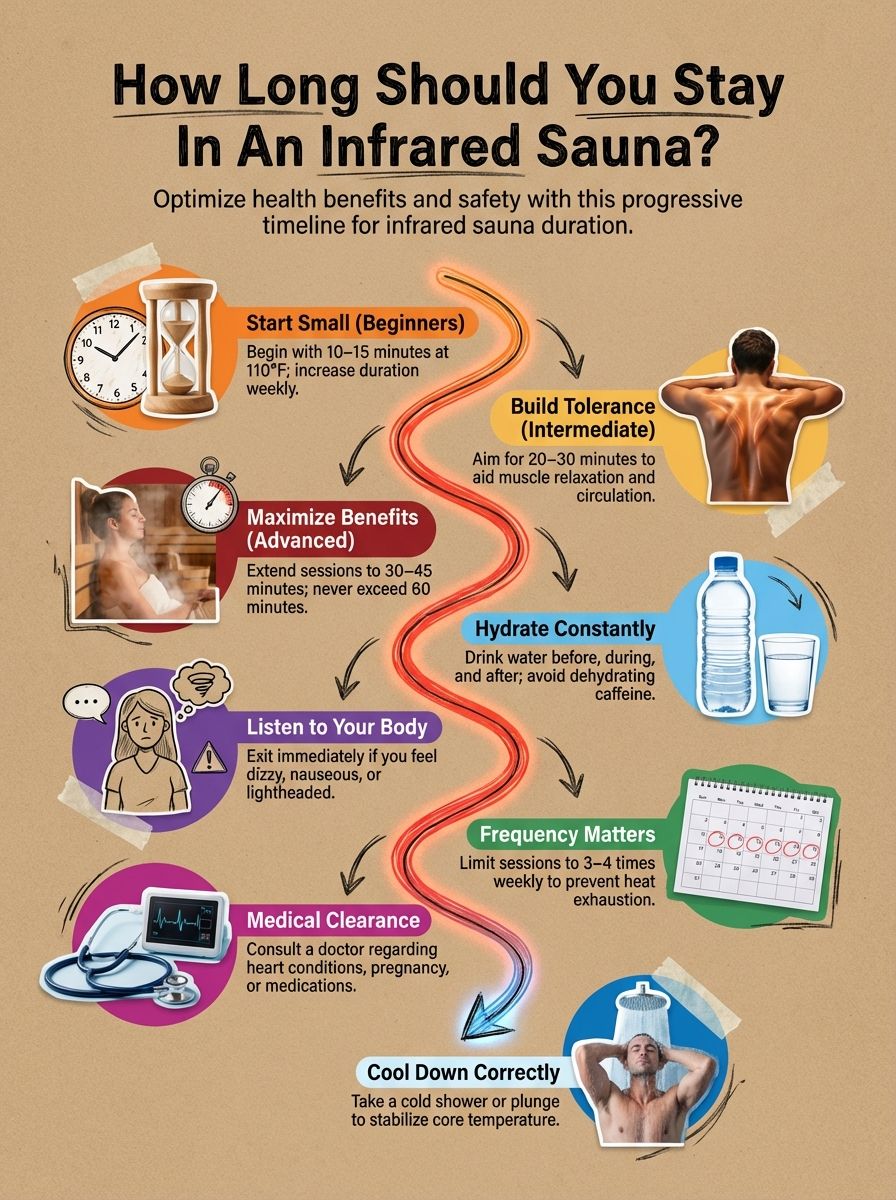
How Long Should You Stay in an Infrared Sauna?
Read article
Infrared Sauna Health Benefits: What a Decade of Building Saunas Reveals
Read articleBuild the Sauna That Makes Daily Sessions Effortless
VantaWave® heaters, Western Red Cedar, optional red light therapy — custom designed for your space and your daily protocol. 3,000+ builds since 2014.