
Can You Cook Food with Infrared Light? The Surprising Science Behind Your Grill, Your Toaster, and Your Sauna
Key Takeaways
- Yes, infrared light cooks food — your grill, broiler, toaster, and campfire all use infrared radiation to transfer heat. It's the most common form of radiant heat transfer in cooking
- Cooking uses near-infrared (0.7–3 microns) from high-temperature sources (400–1000°F). Saunas use far infrared (7–10 microns) from low-temperature sources (200°F). Same physics, very different wavelengths
- You're not being 'cooked' in an infrared sauna — VantaWave® heaters emit at 7.9 microns, a wavelength optimized for gentle, deep-tissue warming at temperatures your body easily regulates
- Infrared is more efficient than convection because it transfers energy directly to the target without heating the air first. This is why infrared grills sear faster and infrared saunas need no preheat
Here's a question that sounds like it belongs in a physics classroom but has a surprisingly practical answer: can infrared light cook food?
Yes. Absolutely. And you've been eating infrared-cooked food your entire life.
Every time you grill a steak over charcoal, broil fish under a heating element, toast bread, or roast a chicken on a rotisserie, infrared radiation is doing the cooking. The glowing red coals, the orange heating elements, the red-hot burner grates — they're all emitting infrared light that transfers energy directly to your food. It's the most natural and ancient form of cooking. Humans have been cooking with infrared since the first campfire.
This raises an interesting question for anyone who owns — or is considering — an infrared sauna: if infrared cooks food, am I cooking myself in my sauna? The short answer is no, and the physics of why not is genuinely fascinating.
What infrared actually is
Infrared radiation is electromagnetic energy — the same fundamental type of energy as visible light, radio waves, and microwaves. It sits on the electromagnetic spectrum between visible light (which you can see) and microwaves (which heat your leftovers). The name means "below red" — infrared wavelengths are just beyond what the human eye can detect at the red end of the visible spectrum.
The Electromagnetic Spectrum
Where infrared lives — between microwaves and visible light
Your sauna 7–15 μm
Your grill 0.7–3 μm
← Longer wavelength / Lower energy
Shorter wavelength / Higher energy →
The infrared range spans a wide territory: from 0.7 microns (near-infrared, just past visible red) to around 1,000 microns (far infrared, approaching microwaves). Within that range, the wavelength determines everything — how deep the radiation penetrates, what it interacts with, and what it's useful for. Near-infrared from a very hot source stays on the surface and is great for searing. Far infrared from a gentle source penetrates deeper and is ideal for therapeutic warming.
You can't see infrared, but you feel it constantly. The warmth of the sun on your face? Infrared. The heat radiating from a campfire even when you're not in the smoke? Infrared. The cozy feeling sitting near a wood stove? Infrared. It's everywhere, and your body is exquisitely tuned to absorb it.
How infrared cooks food
When infrared radiation hits food, the energy is absorbed by water molecules and organic compounds in the food's surface. This absorbed energy converts directly to heat — the molecules start vibrating faster, and the food gets hot. This is fundamentally different from convection cooking (where hot air slowly transfers heat to the food surface) or conduction (where a hot pan transfers heat through direct contact).
Infrared cooking is direct. There's no intermediary — no air that needs to be heated first, no metal surface that needs to reach temperature. The radiation travels from the heat source to the food at the speed of light and begins heating the moment it arrives. This is why infrared grills preheat in minutes while convection ovens take 15–20 minutes — the infrared doesn't need to heat the air inside the grill first.
This directness also explains why infrared creates such beautiful sears. When intense near-infrared radiation hits a steak's surface, the rapid, concentrated energy input triggers the Maillard reaction — the chemical process that creates the brown, flavorful crust on grilled meat. Convection ovens produce the Maillard reaction too, but much more slowly and less intensely. This is why restaurant chefs use salamander broilers (intense overhead infrared) to finish dishes — nothing produces a sear like concentrated infrared radiation.
Infrared vs every other cooking method
How Different Cooking Methods Transfer Heat
Convection
Oven
Hot air circulates around food
Conduction
Pan/Skillet
Heat flows through direct contact
Microwave
Microwave
Waves excite water molecules throughout
Infrared
Grill/Broiler
Radiation heats food directly
Convection (oven): Hot air circulates around the food, gradually transferring heat to the surface. The food heats from the outside in, and the air is the intermediary. It's reliable but slow, and the constant air movement can dry food out. Temperature control is good but imprecise — the air temperature near the top of the oven can be 25°F+ higher than near the bottom.
Conduction (pan/skillet): Heat transfers through direct contact between the hot metal surface and the food. Extremely effective for one surface at a time — that's why you get a great sear on the bottom of a steak in a cast iron pan. But it only works where metal touches food. The rest of the food heats indirectly. You have to flip to cook both sides.
Microwave: Electromagnetic waves at 2.45 GHz penetrate throughout the food and excite water molecules, heating the food from the inside out. Incredibly fast and efficient. But microwaves produce no browning — the surface never gets hot enough for the Maillard reaction. And because microwaves heat water preferentially, dry areas of food heat unevenly.
Infrared (grill/broiler): Electromagnetic radiation transfers energy directly to the food surface. No air intermediary (like convection), no contact requirement (like conduction). The radiation heats the surface intensely, producing rapid browning and searing. Some wavelengths penetrate slightly into the food (a few millimeters), providing more even heating than conduction. Speed, browning quality, and energy efficiency are all superior to convection for most applications.
Real-world infrared cooking you see every day
Once you understand that infrared is a form of cooking, you start noticing it everywhere:
- Charcoal grills: The hot coals emit intense infrared radiation — that's what creates the unmistakable charcoal-grilled flavor. The smoke adds flavor too, but the searing is done by infrared.
- Ceramic infrared grills: Companies like TEC and Solaire build grills with ceramic plates that sit between the gas burners and the cooking grate. The ceramic absorbs heat from the gas flame and re-emits it as intense infrared — producing searing temperatures of 900°F+ at the cooking surface.
- Restaurant salamander broilers: The overhead heating element in a salamander is an infrared emitter. Chefs use them to brown the top of crème brûlée, gratins, and meats — precise, intense infrared from above.
- Toasters: The glowing orange elements in your toaster are emitting near-infrared radiation. That's what browns the bread. If you've ever noticed that the side of the bread facing the element is browner — that's because infrared travels in straight lines.
- Rotisserie ovens: The combination of rotating food past fixed infrared heating elements produces the most even cooking of any method — every surface gets equal infrared exposure.
- Industrial food processing: Large-scale food manufacturing uses infrared for drying (jerky, pasta, spices), roasting (coffee, nuts), and surface pasteurization — because it's faster and more energy-efficient than convection.
So if infrared cooks food — am I cooking myself in my sauna?
No. And the reason is one of the most elegant applications of physics in consumer wellness technology.
The difference between infrared cooking and infrared sauna therapy comes down to wavelength and temperature — and they're connected by a fundamental law of physics called Wien's Displacement Law.
Wien's Law states that the peak wavelength emitted by any heated object is determined by its surface temperature. Hotter objects emit shorter wavelengths (near-infrared, which stays on the surface and is intense). Cooler objects emit longer wavelengths (far infrared, which penetrates gently into tissue).
- Charcoal grill coals: ~1,200°F surface temperature → emits at ~2.5 microns (near-infrared). Stays on the food surface. Intense. Cooks food.
- Broiler element: ~900°F → emits at ~3 microns. Slightly deeper penetration. Still intense enough to brown surfaces rapidly.
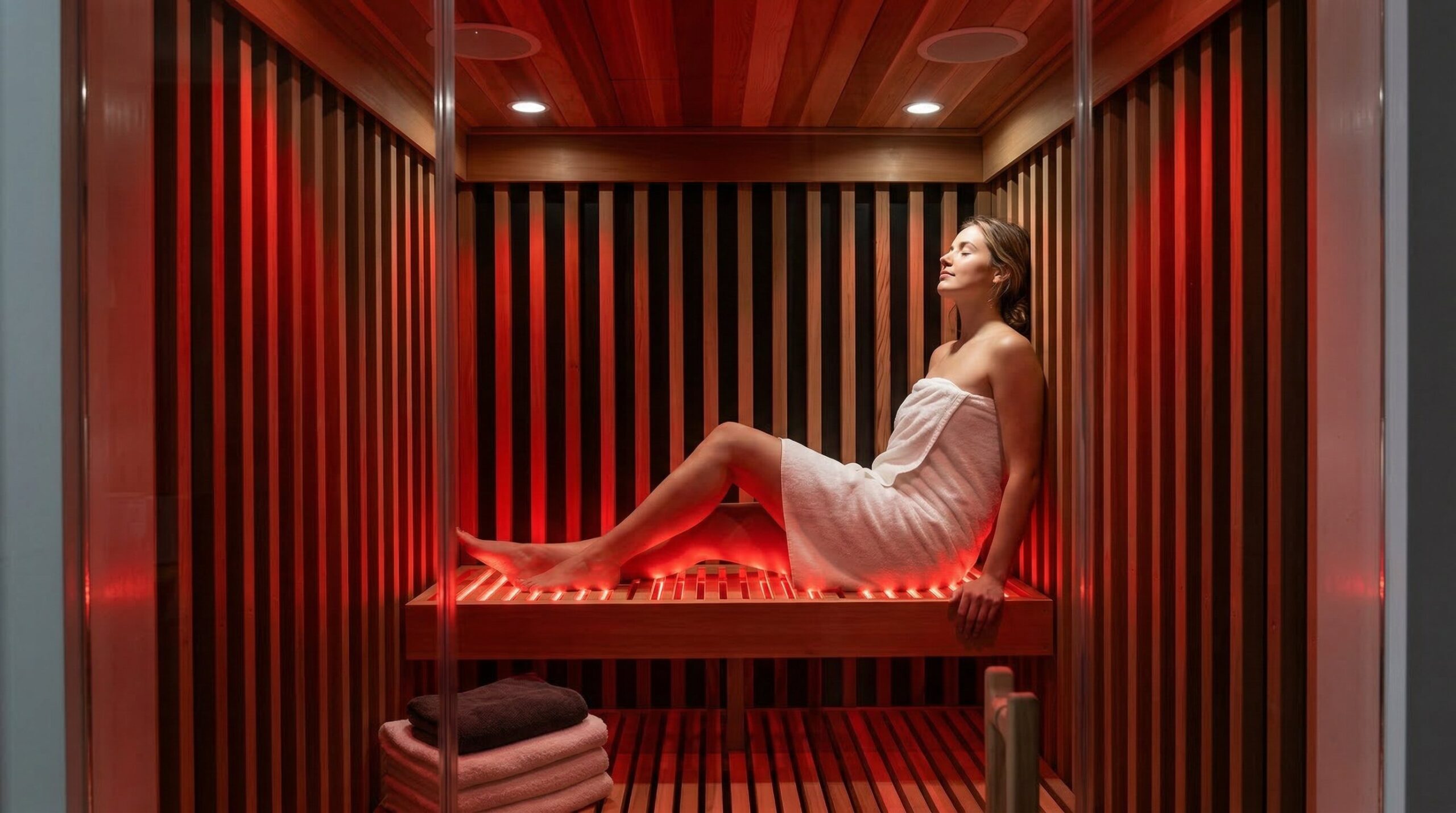
- VantaWave® sauna heater: ~200°F → emits at ~7.9 microns (far infrared). Penetrates 1.5–2 inches into tissue. Gentle. Warms your body therapeutically without burning, searing, or cooking anything.
The 7.9-micron wavelength isn't arbitrary — it's the specific frequency most efficiently absorbed by water molecules in human tissue. Your body is approximately 60% water. Far infrared at this wavelength is absorbed deeply and gently, raising your core temperature by 2–3°F over 30 minutes. That's a therapeutic warming response — the kind that triggers heat shock proteins, increases circulation, and produces a deep sweat. It is not cooking. Your body's thermoregulatory system manages the process effortlessly at these temperatures.
Think of it this way: standing in sunlight on a warm day warms your skin through infrared radiation from the sun. Nobody would call that "cooking yourself." Your infrared sauna produces the same type of warming at a similar intensity — just at a specific wavelength optimized for therapeutic absorption.
What about visible light? Can it cook?
Since the original question mentions visible light — technically, yes. A magnifying glass can focus sunlight (which includes visible and infrared wavelengths) intensely enough to start a fire. Solar ovens use reflectors to concentrate sunlight for cooking. But visible light is much less efficient at heating than infrared because most of it bounces off surfaces (that's why you can see things — reflected visible light hits your eyes) rather than being absorbed as thermal energy.
Infrared, by contrast, is almost entirely absorbed by organic materials. It doesn't bounce — it converts to heat. That's why infrared is the dominant mechanism in radiant heating and cooking, even though sunlight contains both visible and infrared wavelengths. The infrared is doing the thermal work; the visible light is just along for the ride.
For a deeper dive into infrared physics and how it applies to sauna design, explore our complete history of infrared saunas or browse the research library. And if you're curious about how we engineer the 7.9-micron wavelength into every sauna we build, the VantaWave® technology page explains the physics behind the heater.
Frequently asked questions
Frequently Asked Questions
Yes. Infrared radiation is how grills, broilers, toasters, and rotisserie ovens cook food. The hot coals in a charcoal grill, the glowing elements in a broiler, and campfire cooking all use infrared radiation to transfer heat energy directly to food. It's the most common form of radiant cooking.
Same physics, very different application. Infrared grills use short-wavelength, high-temperature infrared (near-IR, from sources at 400–1000°F) to cook food quickly. Infrared saunas use long-wavelength, low-temperature far infrared (from 200°F heaters) to gently warm your body. The wavelength difference means you're being therapeutically warmed, not cooked.
Near-infrared wavelengths (0.7–3 microns) from high-temperature sources are most effective for cooking. These shorter wavelengths produce intense surface heating ideal for searing and browning. Far infrared (7–15 microns) from lower-temperature sources is used for gentle therapeutic heating in saunas.
Infrared radiation transfers energy directly to food without heating the air first. A convection oven must heat air, then the air slowly heats the food surface — an indirect, two-step process. Infrared eliminates the intermediary, delivering energy at the speed of light. No preheat needed, no air circulation required.
Infrared grills can be healthier because they cook faster at higher surface temperatures, reducing the time food spends in the bacterial growth 'danger zone.' They also reduce flare-ups compared to traditional gas grills because fat drippings vaporize on the ceramic plate rather than dripping onto open flames — producing fewer carcinogenic compounds.
Near infrared has shorter wavelengths (0.7–3 microns), comes from very hot sources (400°F+), and stays near the surface — ideal for cooking and searing. Far infrared has longer wavelengths (7–15 microns), comes from lower-temperature sources (~200°F), and penetrates 1.5–2 inches into tissue — ideal for therapeutic warming in infrared saunas.

Founder & Lead Designer, SaunaCloud®
3,000+ custom saunas built since 2014 · Author of The Definitive Guide to Infrared Saunas · Featured in Forbes, Inc., and MSN
Chris has been designing and building custom infrared saunas since 2014. He wrote one of the first comprehensive books on infrared sauna therapy and is personally involved in every SaunaCloud build — from design consultation through delivery and beyond.
Continue Reading
How Infrared Saunas Work: From Photon to Health Effect in Five Steps (2026)
Read articleInfrared Sauna Heater Comparison: Carbon vs Ceramic vs Halogen vs VantaWave® (2026)
Read article
Infrared Sauna Health Benefits: What a Decade of Building Saunas Reveals
Read articleCurious About Infrared? See What a Custom Sauna Looks Like
VantaWave® heaters at 7.9 microns — engineered for your body, not your dinner. Custom designed for your space.