
Can You Cook Food With Infrared Light? (You Already Do — and Here's Why It Matters for Your Sauna) (2026)
Key Takeaways
- You already cook with infrared every day. Every grill, broiler, campfire, and oven uses infrared radiation as a primary heating mechanism. When you broil a steak, the element radiates infrared. When you roast marshmallows, the coals radiate infrared. The air between isn't the main heat carrier — electromagnetic waves are
- Different wavelengths interact with food (and bodies) differently. Microwaves excite water molecules through rotation (deep penetration). Far infrared is absorbed by surface water molecules through vibration (surface heating, conducts inward). Visible light is mostly reflected or transmitted (you can't cook with a flashlight). Same physics explains why infrared saunas heat through surface absorption + circulatory transport
- Your sauna is NOT a microwave. Microwaves use 2.45 GHz to cause water molecule rotation. Infrared uses completely different wavelengths to cause molecular vibration. Different mechanisms, different wavelengths, different effects. You're being warmed by the same physics that makes a campfire feel warm — not the physics inside a microwave oven
- High-end 'infrared grills' market the same physics as a feature: a heated ceramic surface emitting infrared radiation absorbed directly by the food, rather than heating air that heats food. More even cooking, better searing. The physics is identical to an infrared sauna: heated surface → infrared waves → absorbed by target
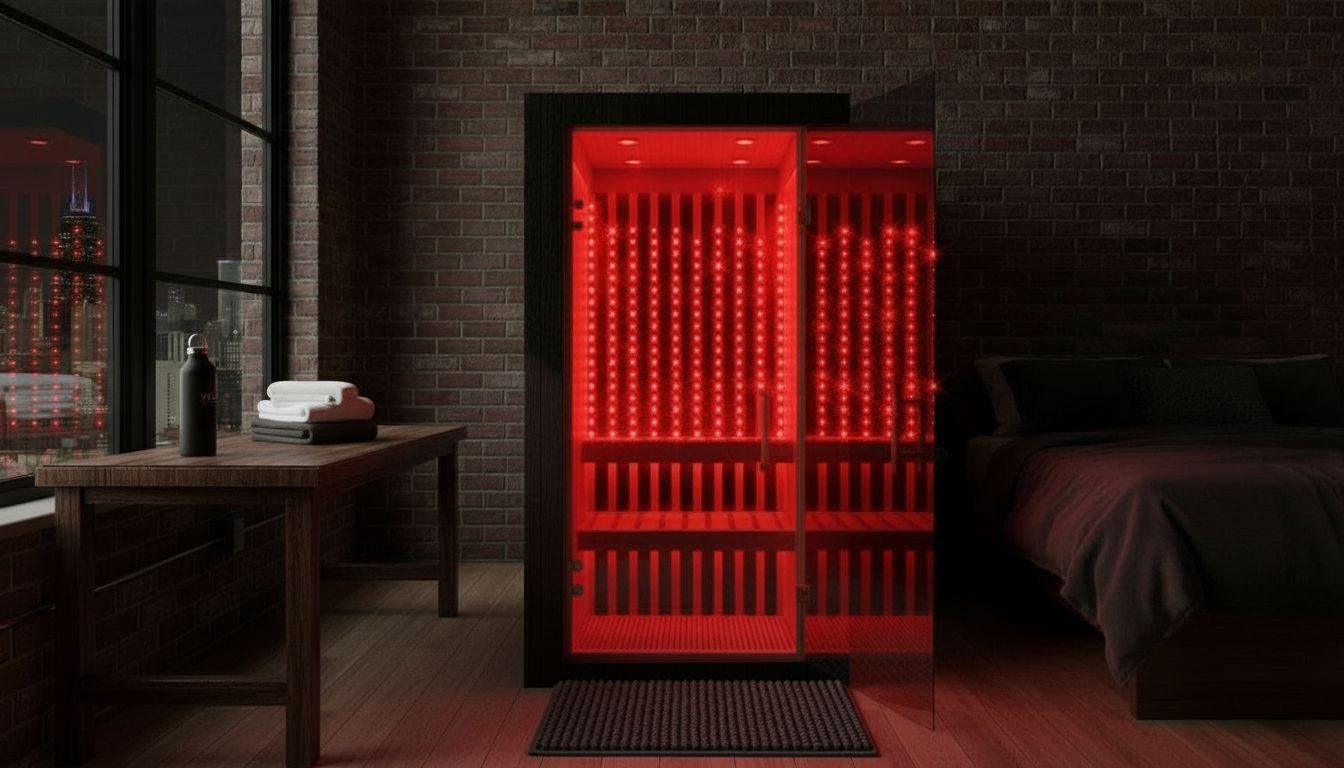
- This everyday physics is what makes your infrared sauna work: heater panels emit far infrared → waves travel through air → absorbed by water molecules in your skin → converted to warmth. The same interaction you've experienced every time you've sat by a fire, grilled food, or felt sun on your face
Can you cook food with infrared light? The surprising answer: you already do. Every single day.
When you broil a steak, the heating element doesn't cook by making the air hot — it emits infrared radiation that's absorbed directly by the meat's surface. When you grill over charcoal, the coals radiate infrared to the food above (notice the hot air rises UP, away from the food, while the heat goes sideways and UP toward the grate). When you roast a marshmallow over a campfire, you're using infrared cooking.
This is the same physics as your infrared sauna. Understanding it through cooking makes the sauna science immediately intuitive.
The wavelength interaction map: why different heat sources cook differently
Microwave (2.45 GHz, ~12cm wavelength): Excites water molecules through rotation — the molecules spin rapidly, generating heat. Penetrates several centimeters into food, heating from inside out. This is why microwaved food can be hot inside while the plate is cool. Completely different physics from infrared.
Far infrared (3-100μm wavelength): Absorbed by water molecules in the surface layers through molecular vibration (not rotation). Heat conducts inward from the surface. Gentle, even, surface-driven heating. This is the wavelength range of infrared sauna heaters — and it's the same interaction with your skin: absorption in the first few millimeters, then circulatory heat transport carries warmth deeper.
Near infrared (0.75-3μm): Higher energy per photon, penetrates somewhat deeper into food and tissue. This is the grilling/broiling range — the glowing-red heating element emits near-infrared alongside visible red light. Also the range used in photobiomodulation (red light therapy).
Visible light (400-700nm): Mostly reflected or transmitted by food surfaces. You can't cook with a flashlight — the photons don't have the right wavelength to be absorbed efficiently by food molecules. Visible light illuminates; infrared heats. Same electromagnetic spectrum, different interactions with matter.
Why your sauna isn't a microwave
This is the most common fear we hear: 'Am I being microwaved?' No. The physics are completely different.
Microwaves use a specific frequency (2.45 GHz) that causes water molecules to ROTATE — spinning rapidly and generating heat through molecular friction. The wavelength (~12cm) penetrates deep into food. Infrared uses completely different wavelengths (3-100μm for far infrared) that cause molecular VIBRATION — a gentle oscillation that converts directly to thermal energy in the surface layers. Different wavelengths, different molecular mechanisms, different penetration depth, different biological effects.
You're being warmed by the same physics that makes a campfire feel warm from across the room. The campfire emits infrared; your skin absorbs it; you feel warmth. That's it. No rotation, no deep penetration, no microwave physics. Just the oldest, most familiar form of heat transfer on Earth.
The infrared grill analogy
High-end grills (TEC, Solaire, Napoleon) market 'infrared grilling' as a premium feature. Instead of heating air with a gas flame (convection), they use ceramic or metal infrared emitter plates that heat to high temperature and radiate infrared directly onto the food. The result: more even cooking, better searing (radiant heat creates a Maillard reaction across the entire surface), less flare-up (less air-based heat means less dripping fat ignition).
The physics is identical to an infrared sauna heater: a heated surface emitting electromagnetic radiation that travels through air and is absorbed by the target — food on a grill, your body in a sauna. The air between is a bystander, not the heat carrier. In both cases, the infrared goes DIRECTLY from emitter to absorber. An infrared sauna is, in a sense, an infrared grill for humans — just at much lower temperatures and much longer wavelengths.
What this means for your sauna
Every intuition you have about cooking with heat applies to your sauna experience. The broiler heats from above (like SaunaCloud's overhead VantaWave panel). The grill provides heat from a surface facing the target. The campfire warms you at a distance without touching you. In each case: a heated surface → infrared waves → absorbed by the target → warmth.
The only difference: your infrared sauna operates at 130-150°F air temperature (heater surface around 150-750°F depending on type), delivering gentle far infrared to your skin. A grill operates at 500-700°F, delivering intense near/mid infrared to your steak. Same physics. Very different temperatures. Your sauna warms you. It does not cook you.
Frequently asked questions
Frequently Asked Questions
Only in the most literal physics sense — infrared energy is absorbed by your tissue and converted to heat, which is technically the same electromagnetic interaction as cooking. But the temperatures are entirely different. Your sauna raises core temp by 0.5-1.5°C. Cooking requires temperatures that denature proteins (above 60°C internally). You're being warmed, not cooked. It's the difference between sitting in a warm room and sitting in an oven.
No — completely different physics. Microwaves use 2.45 GHz frequency to cause water molecule rotation (spinning). Infrared uses entirely different wavelengths to cause molecular vibration (gentle oscillation → warmth). Different wavelengths, different mechanisms, different penetration depth. Your sauna uses the same physics as a campfire, not a microwave.
Visible light photons are mostly reflected or transmitted by food surfaces — they don't have the right wavelength to be efficiently absorbed and converted to heat in food molecules. Infrared photons DO have the right wavelength — they're absorbed by water and organic molecules, converting to thermal energy. That's why a heat lamp (infrared) keeps food warm but a desk lamp (visible) doesn't.
Yes — identical physics. Heated surface → infrared radiation → absorbed by target. The difference is intensity and wavelength range. Infrared grills use near-infrared at very high temperatures (searing). Infrared saunas use far infrared at much lower temperatures (gentle warming). Same electromagnetic interaction, different application.
More than you think. Sitting by a campfire (infrared from coals/flames). Grilling food (infrared from hot grates/coals). Using a broiler (infrared from glowing element). Standing in sunlight (51% of solar energy is infrared). Sitting near a radiator (infrared from hot metal surface). Feeling warmth from another person standing close (they emit infrared at 9.4μm). Infrared is the most common form of heat transfer in daily life.

Founder & Lead Designer, SaunaCloud®
3,000+ custom saunas built since 2014 · Author of The Definitive Guide to Infrared Saunas · Featured in Forbes, Inc., and MSN
Chris has been designing and building custom infrared saunas since 2014. He wrote one of the first comprehensive books on infrared sauna therapy and is personally involved in every SaunaCloud build — from design consultation through delivery and beyond.
Continue Reading

How Infrared Heat Actually Works: The Physics Behind Why You Can Feel a Campfire (2026)
Read article
How Infrared Saunas Work: From Photon to Health Effect in Five Steps (2026)
Read article
Far Infrared and Sunlight: Your Sauna Delivers the Sun's Warmth Without Its Risks (2026)
Read articleExperience the Physics Yourself
The same infrared interaction you've felt from every campfire and every sunny day — custom designed for your home. VantaWave® far-infrared heaters delivering consistent, gentle warmth.