
Infrared Saunas and Blood Pressure: The Observational Promise and the RCT Reality (2026)

Key Takeaways
- The Laukkanen Finnish cohort (2,315+ men, 20+ years) found frequent sauna bathing associated with ~50% reduced fatal cardiovascular events and reduced risk of developing hypertension. A 2023 analysis showed men WITH elevated blood pressure who sauna bathed frequently had lower cardiovascular mortality
- A 2025 meta-analysis of 20 RCTs (passive heating, 2-15 weeks) found NO significant pooled blood pressure reduction. SBP dropped 2.46 mmHg on average but the confidence interval crossed zero. Most other cardiovascular markers also showed no significant change
- The tension may be explained by TIME. Observational studies capture decades of practice. RCTs last weeks. Blood pressure benefits may require months to years — similar to how exercise reduces BP over time but a single 8-week study shows modest results
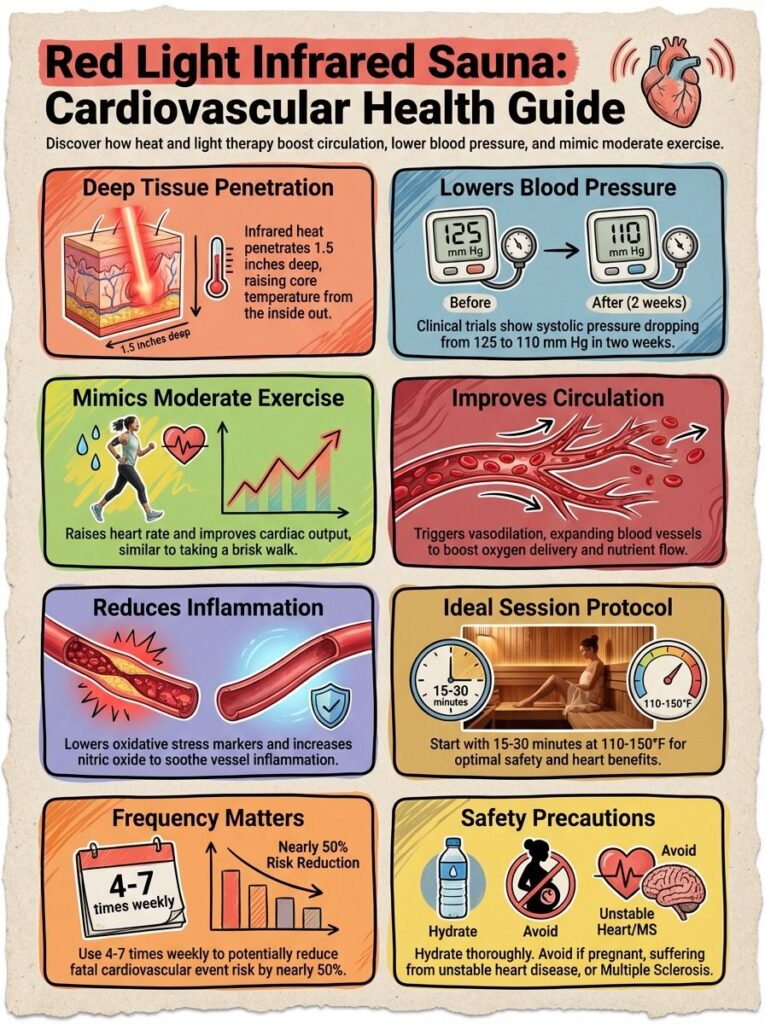
- The acute mechanism is clear: heat → vasodilation → reduced peripheral resistance → BP drops during and after sessions. Ketelhut 2019 showed sauna cardiovascular responses correspond to submaximal exercise — your heart and vessels 'work out' during a session
- If you take blood pressure medication, sauna adds to the BP-lowering effect — risking excessive drops (hypotension, dizziness, fainting). Discuss with your physician. Monitor standing tolerance. Never stop medication because of sauna use
Two large bodies of evidence tell different stories about sauna and blood pressure. Both are well-conducted. Both are published in reputable journals. And they don't quite agree.
The Finnish observational data — following thousands of men for over 20 years — shows dramatic cardiovascular risk reduction with regular sauna use. The 2025 meta-analysis of 20 randomized controlled trials — the gold standard for proving causation — found no significant blood pressure reduction from passive heating interventions.
Most sauna companies cite only the Finnish data. Most skeptics cite only the RCT data. The honest answer requires grappling with both. Here's the complete picture.
The observational evidence: decades of Finnish data
Laukkanen et al. 2015 (JAMA Internal Medicine): 2,315 middle-aged Finnish men followed for a median of 20.7 years. Frequent sauna bathing (4-7 times per week) was associated with approximately 50% reduced fatal cardiovascular events compared to once-weekly use. This remains the foundational study in sauna cardiovascular research.
Zaccardi et al. 2017 (American Journal of Hypertension): From the same cohort — regular sauna use was associated with significantly reduced risk of DEVELOPING hypertension. Clear dose-response relationship: more frequent sauna bathing = lower hypertension incidence.
Laukkanen et al. 2023 (Journal of Nutrition, Health and Aging): Examined the interplay between systolic blood pressure, sauna frequency, and cardiovascular mortality. Key finding: men who ALREADY had elevated blood pressure and who sauna bathed frequently had lower cardiovascular mortality than those with elevated BP who didn't sauna. This suggests sauna may be particularly beneficial for people who already have hypertension.
Kunutsor et al. 2024 (Scandinavian Cardiovascular Journal): Further analyzed the SBP × sauna frequency interaction on mortality risk in 2,575 Finnish men, confirming the dose-response relationship between sauna frequency and cardiovascular protection.
Honest limitations: All observational. All Finnish men. All traditional sauna (not infrared). Correlation, not proven causation. Lifestyle confounding — frequent sauna users may be healthier, more active, and higher socioeconomic status.
The RCT reality: what controlled trials actually show
A 2025 meta-analysis published in the American Journal of Preventive Cardiology pooled 20 randomized controlled trials of passive heating interventions (sauna, hot water immersion, hot yoga, local heating) lasting 2-15 weeks. RCTs are the gold standard for proving causation — if you want to know whether sauna CAUSES blood pressure reduction, this is the evidence that matters most.
The finding: no significant pooled effects for the majority of cardiovascular outcomes. Systolic blood pressure dropped an average of 2.46 mmHg — but the 95% confidence interval crossed zero (-5.02 to 0.10), meaning the effect was not statistically significant. Flow-mediated dilation, pulse wave velocity, heart rate, glucose, and cholesterol also showed no significant pooled changes.
Why this matters: When a confidence interval crosses zero, it means we can't rule out that the true effect is zero — no effect at all. A 2.46 mmHg drop might be real, but based on these 20 RCTs, we can't say so with confidence. This directly challenges the narrative that sauna is a proven blood pressure treatment.
Reconciling the tension: why the data disagrees
The time hypothesis: Observational studies capture DECADES of consistent sauna practice — 4-7 sessions per week for 20+ years. RCTs last 2-15 weeks. Blood pressure benefits from exercise also take months to manifest — a single 8-week exercise trial might show modest or non-significant results, while decades of regular exercise dramatically reduce cardiovascular risk. The same may be true for sauna. The benefit may require years, not weeks.
The dose hypothesis: Finnish sauna culture involves 4-7 sessions per week, often at higher temperatures (170-200°F) for longer durations than many RCT protocols tested. The 'dose' in the observational studies may be substantially higher than what the RCTs delivered.
The confounding hypothesis: People who sauna 4-7 times per week may differ from those who don't in ways beyond sauna use — exercise habits, stress management, social engagement, alcohol patterns, socioeconomic status. Some of the observed benefit may come from these correlated lifestyle factors, not sauna itself.
Honest conclusion: Regular sauna use is ASSOCIATED with dramatically reduced cardiovascular risk in observational data. But the specific claim that sauna LOWERS blood pressure has not been proven by randomized controlled trials. The truth may be that the benefit is real but requires consistent, long-term practice — exactly what the Finnish data captures and what short RCTs miss.
How sauna affects blood pressure (the mechanism)
Acute (during and after each session): Heat causes vasodilation — blood vessels physically widen. This reduces peripheral vascular resistance — the resistance your heart pumps against. Blood pressure drops. Heart rate increases to compensate (cardiovascular workload). Ketelhut and Ketelhut 2019 showed these responses correspond to submaximal dynamic exercise — your cardiovascular system is 'working out' during a sauna session.
Repeated exposure (over weeks to months): Regular heat stress may improve endothelial function — the endothelial cells lining blood vessels produce more nitric oxide (via eNOS upregulation), improving arterial compliance (flexibility). Heat shock proteins protect vascular tissue. Brunt et al. 2016 demonstrated improved endothelial function, reduced arterial stiffness, and lower blood pressure from passive heat therapy in sedentary humans.
For people who can't exercise adequately — elderly, disabled, severe joint pain, chronic fatigue — sauna provides a passive cardiovascular stimulus that mimics exercise hemodynamics. It's not a replacement for exercise, but it's the closest accessible alternative for the cardiovascular system.
A blood pressure support protocol
Frequency: 3-4 sessions per week minimum to match the lower end of study protocols. The Laukkanen dose-response data shows greater benefit with 4-7x/week. Duration: 15-30 minutes at comfortable temperature (130-140°F for infrared). Monitoring: Check blood pressure before and after sessions for the first 2 weeks to understand your personal response. Hydration: Critical — dehydration concentrates blood and temporarily raises BP. Drink 16-24oz water before and after.
The Sastriques-Dunlop et al. 2025 Frontiers in Cardiovascular Medicine review concluded that sauna therapy has emerged as 'a promising intervention for the management of cardiovascular health.' But 'promising' and 'proven' are different words. Position sauna as one component of a cardiovascular health strategy — alongside diet, exercise, stress management, and medical care — not as a standalone blood pressure treatment.
Medication interactions and safety
Blood pressure medication + sauna = additive BP lowering. If you take anti-hypertensives (beta-blockers, ACE inhibitors, ARBs, calcium channel blockers, diuretics), sauna's vasodilatory effect adds to your medication's effect. This can cause excessive blood pressure drops — dizziness, lightheadedness, fainting, falls. This is a safety concern, not a benefit. Discuss with your prescribing physician. Rise slowly after sessions. See our medication interactions guide for drug-specific details.
When NOT to sauna: Uncontrolled severe hypertension (SBP >180 or DBP >120) without physician clearance. Recent stroke or TIA (within 4-6 weeks). Unstable angina. Decompensated heart failure. During any hypertensive crisis. See the heart health page for complete cardiac contraindications.
Never stop or reduce blood pressure medication because of sauna use. 'Natural' doesn't mean 'instead of medication.' Uncontrolled hypertension causes strokes, heart attacks, kidney damage, and vision loss. If sauna contributes to better BP over time, your physician can adjust medication accordingly — that's their decision, not yours.
Why SaunaCloud for cardiovascular health
The observational data suggests the benefit comes from YEARS of consistent daily practice. That requires a sauna in your home — not a gym membership or spa booking. Every SaunaCloud sauna is custom designed and built with VantaWave® far-infrared heaters for consistent, reliable cardiovascular stimulus — available every day, integrated into your life.
Frequently asked questions
Frequently Asked Questions
The observational data (Laukkanen Finnish cohort, 20+ years) shows strong association between frequent sauna use and reduced cardiovascular events/hypertension risk. However, a 2025 meta-analysis of 20 RCTs found no statistically significant blood pressure reduction from passive heating interventions lasting 2-15 weeks. The acute mechanism is clear (vasodilation → BP drop), but the long-term therapeutic claim hasn't been proven by controlled trials. Position sauna as a promising cardiovascular practice, not a proven BP treatment.
Absolutely not. Never stop or reduce blood pressure medication without your physician's explicit guidance. Uncontrolled hypertension causes strokes, heart attacks, and organ damage. If regular sauna use contributes to improved blood pressure over time, your physician can evaluate and adjust medication accordingly — that's a medical decision based on your BP readings, not a self-directed choice based on sauna use.
Yes, with awareness. Anti-hypertensive medications + sauna vasodilation = additive blood pressure lowering, which can cause excessive drops (dizziness, fainting). Start conservatively: lower temperatures, shorter sessions. Rise slowly after sessions — sit for 2-3 minutes before standing. Monitor how you feel. If dizziness occurs, reduce session parameters. Discuss with your prescribing physician.
Likely because of TIME. The Finnish observational studies captured decades of consistent, frequent sauna practice (4-7x/week for 20+ years). The RCTs lasted 2-15 weeks. Cardiovascular adaptations — like those from exercise — may require months to years of consistent practice to manifest as measurable blood pressure changes. Short trials may miss benefits that accumulate over years.
The Laukkanen data shows a dose-response: more frequent = greater benefit. The strongest associations are at 4-7 sessions per week. At minimum, 3-4 sessions per week provides consistent cardiovascular stimulus. Duration: 15-30 minutes at comfortable temperature. The key is CONSISTENCY over months and years, not intensity of individual sessions.
Almost all blood pressure evidence is from Finnish traditional sauna. Limited infrared-specific BP data exists. The acute cardiovascular mechanism (vasodilation from heat) applies to both modalities. Infrared's advantage is practical: lower ambient temperatures allow longer, more comfortable sessions for people with heat sensitivity. But we can't claim infrared is superior to traditional sauna for BP based on current evidence.
The Laukkanen 2023 analysis specifically found that men WITH elevated blood pressure who sauna bathed frequently had lower cardiovascular mortality than those who didn't. This suggests sauna may be particularly beneficial for people who already have hypertension — but this is observational data, not a treatment recommendation. Discuss with your physician, especially regarding medication interactions.

Founder & Lead Designer, SaunaCloud®
3,000+ custom saunas built since 2014 · Author of The Definitive Guide to Infrared Saunas · Featured in Forbes, Inc., and MSN
Chris has been designing and building custom infrared saunas since 2014. He wrote one of the first comprehensive books on infrared sauna therapy and is personally involved in every SaunaCloud build — from design consultation through delivery and beyond.
Continue Reading
Infrared Sauna and Heart Health: From Prevention to Treatment — What the Cardiology Research Shows (2026)
Read article
How Often Should You Use an Infrared Sauna? Research-Backed Frequency for Every Health Goal (2026)
Read article
Infrared Sauna and Medications: A Drug-Class-by-Drug-Class Safety Reference (2026)
Read articleBuild a Daily Cardiovascular Practice
The observational data suggests years of consistent daily use produces the strongest cardiovascular benefit. A home sauna makes that consistency possible.