
Infrared Sauna and Heart Health: From Prevention to Treatment — What the Cardiology Research Shows (2026)
Key Takeaways
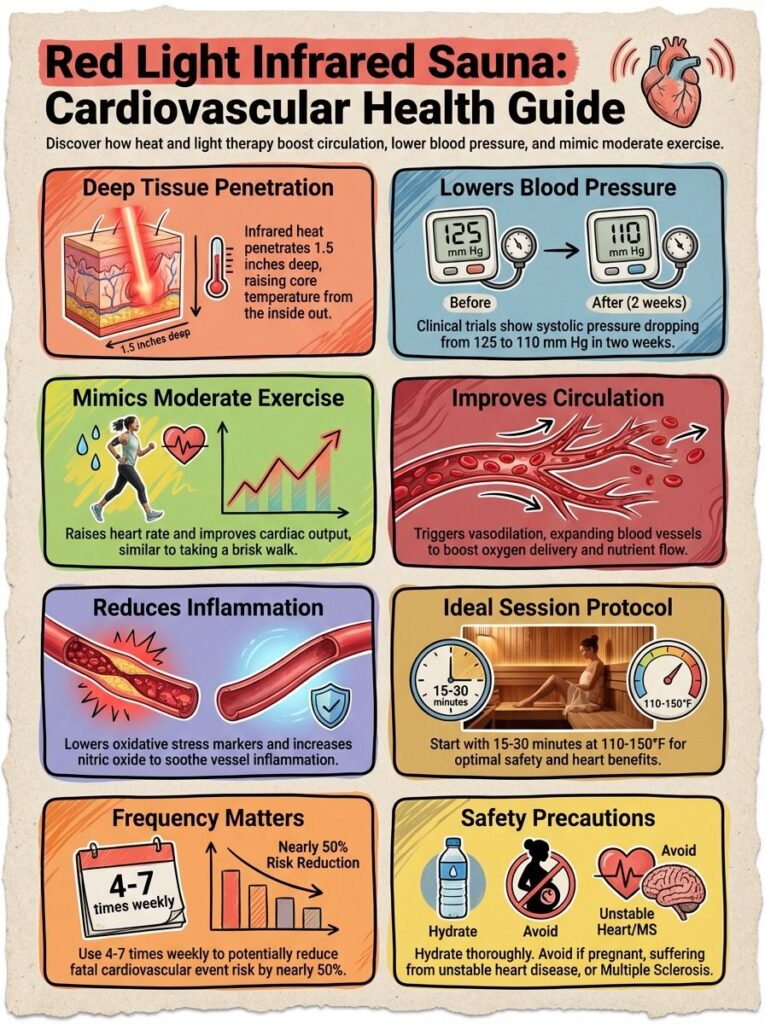
- Cardiovascular health has TWO separate evidence bases for sauna: PREVENTION (Laukkanen: 50% lower CV mortality in healthy men who sauned 4-7x/week over 20 years) and TREATMENT (Waon therapy: meta-analysis of 491 heart failure patients showing improved cardiac function). These are different questions with different data
- Waon therapy — far-infrared sauna at 60°C (140°F) for 15 min followed by 30 min warm blanket rest — was literally invented by Japanese cardiologists to treat heart failure. The WAON-CHF multicenter randomized study demonstrated clinical improvement in ejection fraction and reduced BNP (heart failure biomarker). This IS far-infrared sauna therapy
- A 2025 Frontiers in Cardiovascular Medicine review concluded that sauna therapy has emerged as 'a promising intervention for the management of cardiovascular disease' through vasodilation, endothelial function improvement, nitric oxide upregulation, reduced oxidative stress, and autonomic nervous system rebalancing
- Infrared sauna is NOT universally safe for all cardiac patients. Contraindications include: unstable angina, recent myocardial infarction, severe aortic stenosis, and decompensated heart failure. If you have heart disease, you MUST discuss sauna use with your cardiologist before starting
- For HEALTHY individuals, the prevention argument is compelling: the Laukkanen dose-response shows dramatic risk reduction across sudden cardiac death (63% lower), cardiovascular mortality (50% lower), and all-cause mortality (40% lower) — effect sizes comparable to regular exercise
Heart health is where sauna research is most mature, most rigorous, and most compelling. It's also where the stakes are highest — both the potential benefits and the risks.
Cardiovascular disease kills more people worldwide than any other cause. And the sauna research for heart health isn't just observational correlation — it includes randomized controlled trials on heart failure patients, meta-analyses published in cardiology journals, and a therapy (Waon) that was literally invented by cardiologists to treat diseased hearts.
But there's a critical distinction that every other sauna website misses: the evidence for PREVENTING heart disease in healthy people and the evidence for TREATING existing heart disease are two completely different data sets, with different study designs, different populations, and different implications. Lumping them together is intellectually dishonest — and potentially dangerous.
Two evidence bases: prevention vs treatment
Before we dive into the studies, you need this framework. Everything that follows falls into one of two categories:
Evidence Base 1 — PREVENTION (healthy hearts): Large epidemiological studies tracking healthy populations over decades. The question: does regular sauna use reduce the risk of developing cardiovascular disease? The answer: dramatically, yes — with a clear dose-response relationship. This evidence comes primarily from Finnish cohort studies and tells you about risk reduction in people who don't yet have heart disease.
Evidence Base 2 — TREATMENT (diseased hearts): Randomized controlled trials and clinical studies on patients with existing heart failure, vascular disease, and cardiac dysfunction. The question: can far-infrared sauna therapy improve cardiac function in patients who already have heart disease? The answer: yes, with measurable improvements in ejection fraction, biomarkers, and clinical outcomes. This evidence comes primarily from Japanese cardiology research using Waon therapy.
These are fundamentally different questions. A healthy 45-year-old considering sauna for cardiovascular prevention needs different information than a heart failure patient considering Waon therapy under cardiology supervision. We'll cover both — separately.
Prevention evidence: the Laukkanen data and what it actually shows
Laukkanen et al. 2015 (JAMA Internal Medicine) is the landmark cardiovascular prevention study — and it's worth understanding in full because it's cited by every sauna company on earth, usually without the important caveats.
Study design: 2,315 middle-aged men from eastern Finland, followed for a median of 20.7 years. Sauna frequency was self-reported at baseline and participants were categorized into three groups: 1x/week, 2-3x/week, and 4-7x/week. Outcomes tracked: fatal cardiovascular events, sudden cardiac death, fatal coronary heart disease, and all-cause mortality.
Results (comparing 4-7x/week vs 1x/week): Cardiovascular mortality: 50% lower risk. Sudden cardiac death: 63% lower risk. All-cause mortality: 40% lower risk. There was also a dose-response for session duration: sessions >19 minutes were associated with greater risk reduction than shorter sessions. These are dramatic effect sizes — comparable to the risk reduction from regular moderate exercise.
The honest limitations: This is observational data, not a randomized trial. People who sauna 4-7x/week may differ from 1x/week users in ways beyond sauna use — exercise habits, socioeconomic status, social engagement, alcohol patterns. The study was all male, all Finnish, and used traditional (not infrared) sauna. You cannot definitively conclude that sauna CAUSED the risk reduction — only that frequent sauna users had dramatically lower cardiovascular mortality after controlling for known confounders.
That said, the dose-response relationship (more frequent = greater benefit) and the biological plausibility (well-characterized cardiovascular mechanisms) make the causal argument strong. Subsequent studies from the same cohort have confirmed these findings across additional cardiovascular endpoints. And Brunt et al. 2016 (Journal of Physiology) demonstrated in a controlled interventional study that passive heat therapy improved endothelial function, arterial stiffness, and blood pressure in sedentary humans — providing the mechanistic evidence that supports the epidemiological findings.
Treatment evidence: Waon therapy and heart failure
This is the part most sauna companies either don't know about or don't explain properly. Waon therapy — from the Japanese word for 'soothing warmth' — was invented by Dr. Chuwa Tei at Kagoshima University specifically to treat chronic heart failure. This isn't a wellness brand adapting sauna for a health claim. This is cardiology research, conducted in hospitals, published in cardiology journals, using far-infrared sauna as a medical intervention.
The Waon protocol: Far-infrared sauna at 60°C (140°F) for exactly 15 minutes, followed by 30 minutes of rest wrapped in warm blankets to maintain elevated core temperature. Administered 5x/week for 2-4 weeks in the clinical studies. The blanket rest phase is critical — it extends the duration of vasodilation and thermal stress without the cardiac workload of additional heat exposure.
The meta-analysis (Källström et al. 2018): Pooled 7 studies with 491 heart failure patients (275 Waon therapy, 216 control). All studies used the same infrared/Waon protocol. Three of seven measured outcomes showed statistically significant improvement: ejection fraction (EF — the percentage of blood the heart pumps per beat), BNP (brain natriuretic peptide — a biomarker that rises when the heart is under stress), and cardiothoracic ratio (CTR — the size of the heart relative to the chest, which increases in heart failure). These aren't subjective feel-good measures — they're the same clinical markers cardiologists use to assess heart failure severity.
The WAON-CHF study (Tei et al. 2016, Circulation Journal): The landmark multicenter prospective randomized study. Heart failure patients randomized to Waon therapy vs standard medical care. The Waon group showed significant improvement in cardiac function and clinical status. This is the study that established Waon therapy as a recognized treatment modality in Japanese cardiology.
Kihara et al. 2004 (Circulation): 30 heart failure patients with ventricular arrhythmias, randomized to Waon therapy vs control. The Waon group showed a dramatic reduction in premature ventricular contractions (PVCs) — from 3,097 to 848 per 24 hours (p<0.01). BNP was also significantly reduced. For context, ventricular arrhythmias in heart failure are associated with sudden cardiac death. Reducing PVC burden by 73% is a clinically meaningful result.
Fujita et al. 2011 (Circulation Journal): Demonstrated that Waon therapy reduced oxidative stress markers in chronic heart failure patients. Oxidative stress is both a cause and consequence of heart failure — reducing it may slow disease progression.
The critical connection: Waon therapy uses far-infrared sauna technology — the same wavelength range (5-15μm) used in SaunaCloud's VantaWave® heaters. The clinical results from Waon therapy research apply directly to far-infrared sauna use. When we cite Waon therapy data, we're not borrowing evidence from a different technology — we're citing evidence from the same technology used in a clinical setting.
The five cardiac mechanisms: how infrared sauna affects your heart
The cardiovascular benefits of infrared sauna work through five distinct, well-characterized mechanisms. Understanding these helps explain why the evidence is so strong for heart health specifically — multiple pathways converge on cardiovascular improvement.
1. Endothelial function → vasodilation → reduced afterload: Heat exposure improves the function of endothelial cells — the cells lining your blood vessels. Better endothelial function means better vasodilation (vessel widening), which reduces afterload — the resistance the heart pumps against. A heart pumping against less resistance works more efficiently and with less strain. Brunt 2016 demonstrated measurable endothelial function improvement from passive heat therapy.
2. Nitric oxide upregulation → arterial compliance: Heat activates endothelial nitric oxide synthase (eNOS), increasing nitric oxide production. NO is the primary vasodilator molecule — it relaxes arterial smooth muscle, reducing vascular stiffness. Improved arterial compliance means your arteries flex more with each heartbeat instead of resisting, reducing cardiac workload and blood pressure.
3. BNP reduction → reduced ventricular wall stress: BNP (brain natriuretic peptide) is released by heart muscle cells when they're stretched — it's the primary biomarker for heart failure severity. Multiple Waon therapy studies showed BNP reduction, indicating reduced ventricular wall stress — the heart is under less mechanical strain. This is a direct measure of improved cardiac status.
4. Oxidative stress reduction → less cardiac tissue damage: Fujita 2011 showed Waon therapy reduces oxidative stress in heart failure. Oxidative stress damages cardiac tissue — mitochondrial dysfunction, lipid peroxidation, protein oxidation — all of which worsen heart failure. Reducing oxidative stress through regular heat shock protein activation may slow cardiac tissue deterioration.
5. Autonomic rebalancing → parasympathetic dominance → anti-arrhythmic: Regular sauna use shifts the autonomic nervous system toward parasympathetic (rest-and-digest) dominance. Increased parasympathetic tone is associated with lower arrhythmia risk, improved heart rate variability (HRV), and reduced resting heart rate. The Kihara 2004 PVC reduction data supports this anti-arrhythmic mechanism directly.
Peripheral arterial disease: a niche but important application
Sastriques-Dunlop et al. 2025 (Frontiers in Cardiovascular Medicine) specifically reviewed sauna therapy for peripheral arterial disease (PAD) — a condition where narrowed arteries reduce blood flow to the limbs, causing pain during walking (claudication), poor wound healing, and in severe cases, tissue death requiring amputation.
The mechanism is direct: far-infrared sauna improves peripheral microcirculation through vasodilation and nitric oxide production. For PAD patients, this means more blood flow to the affected limbs — exactly what the disease restricts. The 2025 review concluded that sauna therapy shows promise as a complementary management approach for PAD, alongside standard interventions (exercise therapy, antiplatelet medication, and revascularization when indicated).
If you have PAD, discuss infrared sauna with your vascular specialist. The improved peripheral circulation that healthy users experience as 'warm feet and hands' is a clinically meaningful intervention for people whose limb circulation is compromised.
Contraindications and safety: when sauna is NOT safe for your heart
This section exists because sauna is NOT universally safe for all cardiac patients. The cardiovascular response to heat — increased heart rate, vasodilation, fluid redistribution — is beneficial for most hearts but dangerous for some. Omitting contraindications from a cardiovascular sauna page is irresponsible.
CONTRAINDICATIONS — do NOT sauna without cardiologist clearance if you have: Unstable angina (chest pain at rest or with minimal exertion). Recent myocardial infarction (heart attack within the past 4-6 weeks). Severe aortic stenosis (narrowed aortic valve — heat-induced vasodilation can cause dangerous blood pressure drops). Decompensated heart failure (fluid-overloaded, symptomatic at rest). Uncontrolled arrhythmias. Recent cardiac surgery (within 4-6 weeks).
Generally safe with cardiologist awareness: Stable coronary artery disease (with adequate medical management). Controlled hypertension (on appropriate medication). Old myocardial infarction (fully recovered, stable). Stable, compensated heart failure (NYHA Class I-II). Pacemaker or ICD (the devices function at body temperature — infrared does not affect them; confirm with your cardiologist).
Medication interactions to discuss: Beta-blockers may blunt the heart rate response to heat — this is generally protective but changes the sauna experience. Nitrates combined with heat-induced vasodilation can cause significant hypotension (dizziness, fainting). Diuretics increase dehydration risk. Anticoagulants are generally fine but discuss any concerns. NEVER adjust cardiac medications based on your sauna experience — medication changes are your cardiologist's decision.
Alcohol and sauna — the arrhythmia risk: Alcohol consumption before or during sauna significantly increases arrhythmia risk. The combination of alcohol-induced vasodilation + heat-induced vasodilation + dehydration + autonomic effects creates conditions favorable for cardiac rhythm disturbances. The Finnish data on sauna-related sudden deaths consistently implicates alcohol. Do not combine alcohol and sauna — especially with any cardiac history.
A cardiac-appropriate protocol
If your cardiologist has cleared you for sauna use, here's a conservative protocol designed for cardiac patients — modeled on the Waon therapy research parameters.
Weeks 1-2 (Assessment): Temperature: 130°F (55°C) maximum — below the Waon protocol's 140°F to allow assessment. Duration: 15 minutes. Frequency: 3x per week. Measure blood pressure before and after each session. After the session: rest in a warm robe or blanket for 20-30 minutes (this mirrors the Waon blanket rest and is where much of the vascular benefit occurs). Stay well hydrated. Stop immediately if you experience chest pain, palpitations, dizziness, or unusual shortness of breath.
Weeks 3-4 (Building): If well tolerated: increase to 135-140°F and 4-5x per week. Maintain the post-sauna warm rest period. Continue BP monitoring. Report your sauna protocol and BP readings to your cardiologist at your next appointment.
Ongoing (Maintenance): 140°F, 15-20 minutes, 4-5x per week + 20-30 minute warm rest. This closely mirrors the Waon therapy protocol that produced the clinical results described above. Consistency matters more than intensity — the cardiovascular benefits are cumulative, building over weeks and months of regular use.
Stop immediately and contact your doctor if: Chest pain or pressure during or after sauna. Heart racing or palpitations that don't resolve within 5 minutes of exiting. Dizziness or lightheadedness that persists after sitting down and drinking water. Unusual shortness of breath. Any symptoms that feel different from your normal cardiac baseline.
The honest assessment: what sauna can and can't do for your heart
Strong evidence supports: Reduced cardiovascular mortality risk with regular use (Laukkanen — prevention). Improved ejection fraction in heart failure (Waon meta-analysis — treatment). Reduced BNP / ventricular wall stress (multiple Waon studies). Improved endothelial function and arterial compliance (Brunt 2016). Reduced ventricular arrhythmias in heart failure (Kihara 2004). Improved peripheral circulation for PAD (Sastriques-Dunlop 2025 review).
The evidence does NOT support: Cholesterol reduction. Beever 2009 (Canadian Family Physician) specifically found 'consistent fair evidence to refute claims regarding cholesterol reduction' from far-infrared sauna. If a sauna company claims their product lowers cholesterol, they're contradicting the published evidence.
Important context: Sauna COMPLEMENTS cardiac care — it never replaces it. Statins, beta-blockers, ACE inhibitors, anticoagulants, and other cardiac medications exist because they save lives. Sauna provides additional cardiovascular benefit on top of medical management. Tell your cardiologist about your sauna use so they have the complete picture.
Why SaunaCloud for cardiovascular health
The Waon therapy protocol requires consistent daily use — 5x/week for optimal results. That level of consistency requires a sauna in your home, not a gym membership or spa appointment. Every SaunaCloud sauna uses VantaWave® far-infrared heaters operating in the same 5-15μm wavelength range used in the Waon therapy clinical trials.
Every unit is custom designed and built with full-surround heater placement for even, consistent temperature — no hot spots, no cold spots, uniform cardiovascular stimulus across your entire body. Optional red light therapy integration at 660nm + 850nm adds photobiomodulation benefits for vascular endothelial function and circulation.
Frequently asked questions
Frequently Asked Questions
Not immediately. During the acute recovery phase (first 4-6 weeks), your heart is healing and the cardiovascular stress of sauna is contraindicated. After recovery, with explicit cardiologist clearance, sauna is generally safe for stable post-MI patients — and the Waon therapy data suggests it may be actively beneficial. The key: your cardiologist makes the timing decision, not you and not a sauna company.
Absolutely not. Sauna complements cardiac medication — it never replaces statins, beta-blockers, ACE inhibitors, ARBs, anticoagulants, or any other prescribed cardiac drugs. These medications have decades of RCT evidence for preventing heart attacks, strokes, and cardiac death. Sauna provides additional cardiovascular benefit ON TOP of medical management. Never adjust medication based on your sauna experience.
Generally yes. Pacemakers and ICDs are designed to function at body temperature — and infrared sauna does not raise core temperature high enough to affect device function. The electromagnetic emissions from far-infrared heaters do not interfere with cardiac device electronics. That said, confirm with your cardiologist and device manufacturer for your specific device. And always carry your device identification card.
Same technology, specific protocol. Waon therapy uses far-infrared sauna at 60°C (140°F) for exactly 15 minutes, followed by 30 minutes of rest wrapped in warm blankets. The blanket rest phase extends vasodilation and the thermal benefit without additional heat exposure. You can replicate this protocol at home with any far-infrared sauna — set to 140°F, 15 minutes, then wrap in a warm robe or blanket and rest for 30 minutes. The protocol matters as much as the technology.
No. The evidence does NOT support cholesterol reduction from sauna use. Beever 2009 (Canadian Family Physician) specifically found 'consistent fair evidence to refute claims regarding cholesterol reduction.' If your cholesterol needs management, that's a conversation with your doctor about diet, exercise, and potentially statin therapy — not a sauna purchase.
Both improve cardiovascular function through different but complementary mechanisms. Exercise builds cardiorespiratory fitness — VO2max, cardiac stroke volume, aerobic enzyme capacity. Sauna provides passive cardiovascular conditioning — vasodilation, endothelial function, autonomic rebalancing, heat shock protein activation. Combined is ideal. For patients who can't exercise adequately due to heart failure, mobility limitations, or orthopedic issues, sauna provides a partial cardiovascular stimulus — this is exactly why Waon therapy was invented.
Discuss with your cardiologist — AFib and sauna is complex. The autonomic effects of sauna (parasympathetic activation) could theoretically help by reducing sympathetic triggers for AFib. But heat stress, dehydration, and electrolyte shifts could also trigger episodes in susceptible individuals. Some AFib patients tolerate sauna well; others find it triggers episodes. Your cardiologist knows your AFib pattern and can advise. If cleared, start very conservatively and monitor.
Share two studies: the Källström et al. 2018 meta-analysis (7 studies, 491 heart failure patients, published in Complementary Therapies in Medicine) and the WAON-CHF multicenter prospective randomized study (Tei et al. 2016, Circulation Journal). Both are published in peer-reviewed journals that cardiologists recognize. Waon therapy is well-established in Japanese cardiology but less known in Western practice — your cardiologist will appreciate the evidence-based approach.

Founder & Lead Designer, SaunaCloud®
3,000+ custom saunas built since 2014 · Author of The Definitive Guide to Infrared Saunas · Featured in Forbes, Inc., and MSN
Chris has been designing and building custom infrared saunas since 2014. He wrote one of the first comprehensive books on infrared sauna therapy and is personally involved in every SaunaCloud build — from design consultation through delivery and beyond.
Continue Reading
Infrared Saunas and Blood Pressure: What the Research Actually Shows (2026)
Read article
Infrared Sauna and Longevity: A Hallmarks-of-Aging Analysis (2026)
Read article
Infrared Saunas and Your Nervous System: The Science of the Parasympathetic Shift (2026)
Read articleBuild Cardiovascular Wellness Into Your Daily Routine
VantaWave® far-infrared heaters operate in the same wavelength range used in Waon therapy clinical trials. Custom designed for your space, built for daily consistency.