
Infrared Sauna and Meditation: Your Sauna Is Already a Meditation Device (The Neuroscience Proves It) (2026)
Key Takeaways
- A 2023 EEG study measured brain activity before and after sauna bathing and found increased theta and alpha power — the EXACT SAME brainwave patterns documented in meditation research. The study's authors explicitly noted the results were 'very similar to a previous study on meditation'
- This means your sauna isn't just a pleasant PLACE to meditate — the heat itself induces meditation-like neural states even without intentional practice. For people who 'can't meditate' because their mind races, sauna provides the neurological nudge that makes meditative states accessible
- The 'enforced mindfulness' effect: in a sauna, you can't scroll your phone, multitask, or avoid your thoughts. The environment naturally creates the conditions meditation teachers spend years cultivating — single-pointed sensory awareness, digital disconnection, and acceptance of physical sensation
- The UCSF depression study combined infrared sauna with cognitive behavioral therapy and achieved 86% remission from major depressive disorder — demonstrating that the integration of heat therapy with psychological practice produces outcomes neither achieves alone
- You don't need to be a 'meditator' to benefit. Simply sitting quietly in your sauna and paying attention to the physical sensations of heat, breath, and sweat IS a form of mindfulness practice — and the heat is doing half the neurological work for you
What if I told you that you've been meditating every time you sit in your sauna — even if you've never meditated a day in your life?
A 2023 neuroscience study measured brain activity before and after sauna bathing using EEG electrodes. What they found was striking: sauna produced significant increases in theta and alpha brainwave power — the exact same patterns that decades of meditation research have documented. The researchers themselves noted the results were 'very similar to a previous study on meditation.'
Your sauna isn't just a warm room. It's a meditation device that works whether you know it's working or not.
What happens to your brain in a sauna (EEG evidence)
Chang et al. 2023 (PLoS One) published a study titled 'A study on neural changes induced by sauna bathing: Neural basis of the totonou state.' Twenty healthy participants underwent EEG measurement before, during, and after sauna bathing. The researchers were looking for the neurological basis of 'totonou' — a Japanese concept meaning the body and mind are 'automatically conditioned,' restored to their original, optimal state.
Theta power INCREASED: Theta waves (4-8 Hz) are associated with deep meditation, heightened awareness, cognitive and emotional processing, and memory clarity. They're the brainwaves that experienced meditators spend years training themselves to access. The sauna produced them automatically.
Alpha power INCREASED: Alpha waves (8-13 Hz) are associated with relaxed alertness, creativity, reduced anxiety, and what psychologists call 'flow state.' Alpha is the brainwave signature of a calm, focused mind — present but not straining. The opposite of the beta-wave-dominated state most of us live in all day.
Heart rate DECREASED. Reaction time IMPROVED — meaning mental clarity, not sluggishness. Participants reported increased happiness, well-being, and mental relaxation. An AI classifier trained on the EEG data achieved 88.34% accuracy in distinguishing the 'totonou' (deep well-being) brain state from baseline.
This isn't someone claiming they 'felt calm' after a sauna. This is electrode-measured brain activity showing that heat exposure produces the neurological signature of meditation. The study explicitly states the results were 'very similar to a previous study on meditation' — not metaphorically similar. Neurologically similar.
Enforced mindfulness: how heat does what willpower can't
The #1 barrier to meditation: 'I can't stop my mind from racing.' The #2 barrier: 'I can't sit still.' The #3 barrier: 'I get bored.' These aren't personal failures — they're features of a nervous system that evolved to scan for threats, not sit quietly. Meditation asks you to override millions of years of evolutionary wiring using willpower alone.
The sauna eliminates all three barriers — not through willpower, but through environment.
Sensory anchoring: The physical sensation of heat is so present and unavoidable that it naturally anchors attention to the body. This is what meditation teachers call 'embodied awareness' — and heat provides it automatically. You don't need to 'try' to focus on your body when it's 135°F. The heat is already there, demanding your attention. Your racing mind has something tangible to land on.
Digital disconnection: Phones don't survive well in saunas. Even if you bring one, sweaty hands and fogged screens make scrolling impractical. For the first time all day, you're unreachable. No notifications. No feeds. No emails. This is what meditation retreats charge $5,000 for — forced disconnection from the digital world. Your sauna provides it daily, for free.
Discomfort as teacher: Heat creates mild discomfort that you learn to sit with rather than escape from. This is literally the core skill of meditation — observing sensation without reactivity. Every sauna session trains this capacity. Can you feel the heat on your shoulders without tensing? Can you notice the urge to leave without acting on it? These aren't sauna questions. They're meditation questions. The sauna just makes them physical and immediate.
Time-bounded container: A 30-minute sauna session gives meditation a clear beginning and end — none of the 'how long should I meditate?' ambiguity that stops beginners. You enter, you sit, the timer goes off, you exit. The container is built in.
Two ways your sauna changes your brain
There are two distinct pathways to the mental clarity that sauna users consistently report — and understanding them changes how you think about your daily session.
The passive pathway (the sauna does the work): Heat activates serotonin-producing cells in the midbrain (Raison 2016). Heat induces theta and alpha brainwave patterns (Chang 2023). Heat triggers parasympathetic nervous system activation, shifting you from fight-or-flight to rest-and-digest. Heat releases endorphins — the same neurochemicals behind 'runner's high.' You get ALL of these benefits just by sitting there. No technique required. No experience necessary. No meditation teacher needed.
The active pathway (you enhance with intentional practice): Breath awareness — focusing on the sensation of warm air entering your nostrils. Body scanning — systematically noticing heat sensation in each body part. Heat acceptance — practicing non-reactivity to discomfort. Gratitude — the warmth naturally evokes appreciation. Visualization — mental imagery enhanced by the theta brainwave state that heat induces.
The passive pathway gives you the majority of the benefit. The active pathway deepens it. But here's the beautiful part: even 'failed' meditation in a sauna still produces meditation-like brain states from the heat alone. You can sit there with your mind racing, feeling like you're 'doing it wrong,' and your brain is still shifting into theta and alpha. The heat doesn't care about your technique.
When heat meets therapy: the UCSF depression study
The synergy between heat therapy and psychological practice isn't hypothetical — it's been tested in one of the most rigorous mental health studies of the past decade.
Mason et al. 2024/2025 (UCSF) combined infrared sauna sessions with cognitive behavioral therapy (CBT) for patients with major depressive disorder. CBT includes mindfulness components — cognitive restructuring, awareness of thought patterns, present-moment focus. The result: 86% remission from major depression. Neither heat therapy alone nor CBT alone has achieved remission rates that high.
Earlier, Raison et al. 2016 (JAMA Psychiatry) showed that a single whole-body hyperthermia session produced depression symptom improvement lasting six weeks. The proposed mechanism: heat stimulates serotonin-producing neurons in the dorsal raphe nucleus of the midbrain — the same system targeted by SSRI antidepressants.
If heat therapy alone improves depression for six weeks, and heat combined with psychological practice achieves 86% remission, the message is clear: the integration of sauna with intentional mind-body practice produces outcomes that neither achieves alone. Your sauna session IS a therapeutic intervention — especially when combined with even basic mindfulness.
Five meditation techniques designed for the sauna environment
These aren't generic meditation instructions repackaged with the word 'sauna.' Each technique is specifically designed to leverage the unique sensory environment that infrared heat creates.
1. Heat Breath Meditation (beginner, 10 minutes): Sit comfortably. Close your eyes. Focus entirely on the sensation of warm air entering your nostrils and filling your lungs. Notice the temperature difference between inhale (warm air in) and exhale (warmer air out). Notice how the warmth feels in your throat, your chest, your belly. When your mind wanders — and it will — return to the warmth of breath. The heat makes the breath sensation vivid and easy to track, unlike room-temperature meditation where the breath sensation is subtle and easy to lose.
2. Progressive Heat Scan (intermediate, 15 minutes): Starting at the top of your head, slowly move your attention through each body part, noticing where you feel the infrared heat most intensely. Forehead. Cheeks. The back of your neck. Shoulders. Chest. Upper arms. Forearms. Hands — notice how your palms feel different from your knuckles. Abdomen. Lower back. Thighs. Calves. The tops of your feet. The soles. The varying heat intensity across your body creates a natural 'map' for body scan meditation — some areas absorb more infrared than others, giving you a richly textured landscape of sensation to explore.
3. Sweat Drop Awareness (intermediate, ongoing): As you begin sweating, choose one droplet of sweat and follow its path down your skin with your full attention. Notice its speed, its route, when it pauses at a pore or changes direction. When it merges with another droplet or reaches the bench, choose another. This single-point focus technique is surprisingly engaging — the unpredictability of each droplet's path holds attention naturally. It trains the same concentration skill as candle-gazing meditation, but with a moving object.
4. Thermal Acceptance (advanced, 20+ minutes): As the sauna heats up and discomfort increases, practice observing the sensation without labeling it as 'bad.' Notice: where exactly do you feel discomfort? Does it pulse or hold steady? Does it have edges? Is it truly 'pain' or just 'intensity'? Can you breathe into it? This is the core mindfulness skill — observing experience without reactivity — and the sauna provides a controlled, safe environment to practice it. The discomfort is real but temporary and harmless, making it an ideal training ground for the non-reactive awareness that transforms daily life.
5. Post-Session Awareness (5 minutes after exiting): After stepping out of the sauna, sit quietly for five minutes. Don't reach for your phone. Notice the dramatic shift in sensation — cool air on hot skin, the tingling of evaporating sweat, your heart rate settling, the deep relaxation spreading through your body. This post-session window is when the totonou state peaks. The theta and alpha waves are at their strongest. The contrast between heat and cool air amplifies sensory awareness. These five minutes may be the most neurologically 'meditative' part of your entire day.
From habit to ritual: making your daily session a sanctuary
The difference between a habit and a ritual is intention. Your sauna session can be 30 minutes of sweating while your mind replays the day's anxieties — or it can be 30 minutes of the most productive inner work you do all day. The heat provides the same neurological benefits either way, but adding intention transforms the experience.
Same time each day: Creates a circadian anchor. Your nervous system begins downshifting before you even enter the sauna because it knows what's coming. Pre-session intention: Before entering, set one word — 'calm,' 'clarity,' 'gratitude,' 'release.' This takes three seconds and frames the entire session. Phone stays outside: Non-negotiable. The enforced mindfulness only works if the enforcement is real. Post-session silence: Five minutes of quiet before re-engaging with the world. This is where the totonou state integrates. One-sentence journal: After your session, write one sentence about what you noticed. Over weeks, this builds a remarkable record of your inner landscape.
Most of our customers who build a sauna for physical health benefits report that the mental and meditative benefits become the primary reason they use it daily. The health benefits get them in the door. The sanctuary keeps them coming back.
Why SaunaCloud for a meditation practice
A meditation practice requires consistency — and consistency requires a sauna in your home, not a gym trip or spa booking. Every SaunaCloud sauna is custom designed and built for your specific space, with VantaWave® far-infrared heaters that provide the same deep-penetrating infrared wavelengths that produce the theta/alpha brainwave changes documented in the Chang 2023 study.
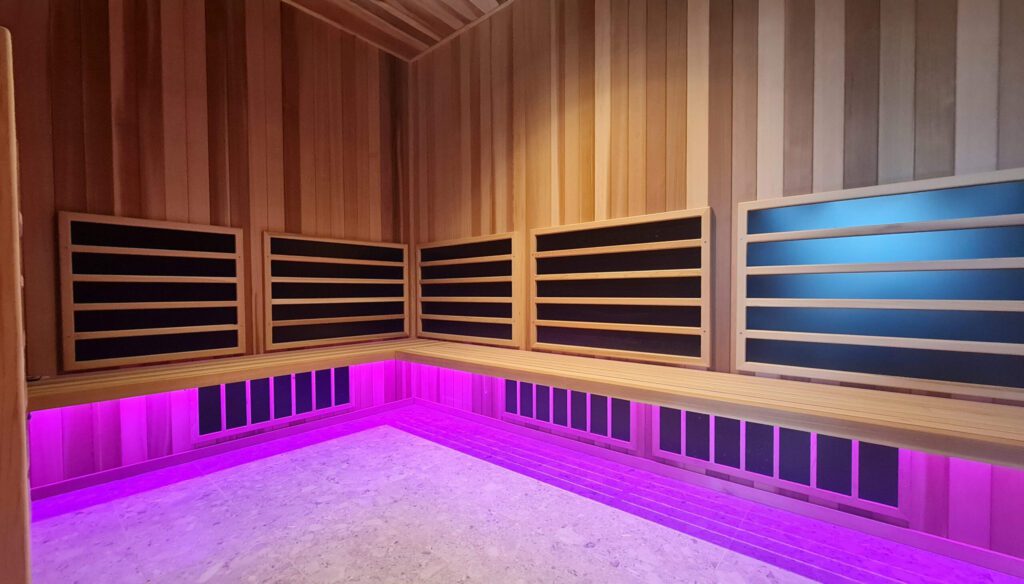
The design matters for meditation: full-surround heater placement creates uniform heat with no hot spots or cold spots that would distract from sensory awareness. Low-EMF construction eliminates electromagnetic noise. The enclosed, warm, quiet space becomes your daily sanctuary — always available, always private, always ready.
Frequently asked questions
Frequently Asked Questions
Yes — this is the entire point. The Chang 2023 EEG study showed that sauna produces meditation-like brainwave patterns (theta and alpha) automatically, without any meditation technique. You don't need to 'quiet your mind' or 'stop thinking.' The heat does the neurological work. Simply sitting quietly and noticing the sensation of warmth IS a form of mindfulness practice. And even if your mind races the entire time, your brain is still shifting into meditative brainwave patterns from the heat alone.
Either works, and both are better than scrolling your phone. But try silence at least once — you might surprise yourself. The heat alone provides enough sensory input to hold your attention. Music can enhance relaxation, and guided meditations can provide structure for beginners. But silence in a warm sauna is a unique and powerful experience that most people never try because they're afraid of being alone with their thoughts. The heat makes it easier than you expect.
The core claim — that sauna produces meditation-equivalent brainwave patterns — comes from Chang et al. 2023, published in PLoS One, a peer-reviewed scientific journal. The findings are based on EEG electrode measurements, not self-reported feelings. The depression connection comes from Mason 2024/2025 (UCSF, infrared sauna + CBT, 86% remission) and Raison 2016 (JAMA Psychiatry, whole-body hyperthermia for depression). This is neuroscience, not marketing.
The heat provides two advantages that seated meditation doesn't. First, a powerful sensory anchor — the physical sensation of warmth gives your attention something tangible to focus on, making it easier to stay present. Second, a passive neurological component — the theta/alpha brainwave induction from heat occurs automatically, supplementing whatever active meditation practice you're doing. Many experienced meditators report that their sauna sessions produce deeper states than their regular seated practice.
Moderate: 125-135°F. Too hot and you're focused on survival, not mindfulness — your attention narrows to 'I need to get out' rather than expanding into awareness. The discomfort should be mild enough to observe without overwhelming. You want warmth that's noticeable and grounding, not heat that's distracting. As you build tolerance over weeks, you may find higher temperatures still allow meditative states — but start moderate.
Both work, for different reasons. Morning sessions set an intention and clarity that carries through the day — the theta/alpha state primes your brain for focused, creative work. Evening sessions release accumulated stress and transition your nervous system into parasympathetic mode for better sleep. The meditation benefits are time-independent. Choose based on your schedule and what you need most: morning clarity or evening release.
The totonou state — the peak of theta/alpha brainwave activity — occurs in the minutes immediately after exiting the sauna and typically lasts 15-30 minutes. The broader mood and clarity benefits persist longer. Regular users report that the cumulative effect of daily sauna meditation builds over weeks — baseline anxiety decreases, sleep improves, emotional reactivity decreases. The acute state fades in minutes; the chronic adaptation builds over months.

Founder & Lead Designer, SaunaCloud®
3,000+ custom saunas built since 2014 · Author of The Definitive Guide to Infrared Saunas · Featured in Forbes, Inc., and MSN
Chris has been designing and building custom infrared saunas since 2014. He wrote one of the first comprehensive books on infrared sauna therapy and is personally involved in every SaunaCloud build — from design consultation through delivery and beyond.
Continue Reading
Infrared Saunas and Your Nervous System: The Science of the Parasympathetic Shift (2026)
Read article
Infrared Saunas and Sleep: The Science of Why Heat Therapy Works (2026)
Read article
Infrared Saunas for Pain Relief: What the Research Shows (2026)
Read articleBuild a Daily Meditation Sanctuary Into Your Home
Your sauna is already a meditation device — the neuroscience proves it. Custom designed for your space, built for daily practice, always available when you need it.