
Infrared Saunas for Seniors: Cardiovascular, Cognitive, and Quality of Life Benefits (2026)
.jpg)
Key Takeaways
- The Laukkanen Finnish cohort IS a seniors study. The 2,315 men were 42-60 at enrollment and followed for 20+ years. The cardiovascular, cognitive, and mortality benefits were measured in exactly this age group — making the data directly applicable to older adults considering sauna
- Cognitive protection: Laukkanen 2017 found 4-7x/week sauna use associated with 66% reduced Alzheimer's risk and 65% reduced dementia risk compared to 1x/week. Combined with BDNF increases and cerebral blood flow improvements from heat exposure, this is the most compelling evidence for seniors specifically
- Infrared saunas operate at 130-150°F — significantly lower than traditional saunas at 170-200°F. This makes infrared more tolerable for older adults who find extreme heat overwhelming, have respiratory sensitivity, or take medications that impair thermoregulation
- CRITICAL SAFETY: Seniors are the highest-risk population for post-sauna falls. Orthostatic hypotension (blood pressure drop when standing) is already common in older adults — sauna-induced vasodilation compounds this. Transition slowly, sit 2-3 minutes before standing, ensure handrails are accessible, keep water within reach
- Older adults take more medications. Polypharmacy combined with sauna creates complex interactions — beta-blockers, diuretics, blood pressure medications, and sedatives all interact with heat exposure. Review your complete medication list with your physician before starting
The most important sauna study ever published is, at its core, a study about older adults.
The Laukkanen Finnish cohort — 2,315 men aged 42-60 at enrollment, followed for over 20 years — measured cardiovascular mortality, cognitive decline, and all-cause death in exactly the demographic most likely to be reading this page. When we cite '50% reduced cardiovascular mortality' or '66% reduced Alzheimer's risk,' we're talking about men who were YOUR age when the study began.
This page covers what that data means for you, what additional benefits infrared sauna offers aging bodies specifically, and — critically — the safety protocols that make sauna use appropriate and safe for older adults.
Cognitive protection: the most compelling evidence for seniors
Laukkanen et al. 2017 found that men who used the sauna 4-7 times per week had 66% lower risk of Alzheimer's disease and 65% lower risk of dementia compared to those who sauna bathed once per week. The dose-response was clear: more frequent sauna use = greater cognitive protection.
The proposed mechanisms align with what we know about cognitive aging: heat shock proteins protect neurons and clear misfolded proteins (the hallmark of Alzheimer's). BDNF (brain-derived neurotrophic factor) increases with heat exposure — promoting neuroplasticity and new neural connections. Improved cerebral blood flow delivers more oxygen and nutrients to brain tissue. Reduced systemic inflammation (neuroinflammation is increasingly linked to dementia).
Honest caveat: This is observational data — correlation, not proven causation. The study was Finnish men using traditional saunas. But the effect sizes are large, the dose-response is consistent, and the biological mechanisms are plausible. For a condition with no cure and limited pharmaceutical options, the signal deserves attention.
Cardiovascular benefits in aging
The same Laukkanen cohort showed 50% reduced fatal cardiovascular events and 40% reduced all-cause mortality with frequent sauna use. Waon therapy (far-infrared sauna at 60°C) was specifically developed and tested for heart failure — a condition predominantly affecting older adults. The meta-analysis of 491 heart failure patients showed improved ejection fraction and reduced BNP.
For seniors, the cardiovascular benefits include improved endothelial function (better blood vessel flexibility), blood pressure support, and passive cardiovascular conditioning. Ketelhut 2019 showed sauna cardiovascular responses correspond to submaximal exercise — for seniors who can't exercise vigorously due to joint pain, balance issues, or cardiac limitations, sauna provides a cardiovascular stimulus without the physical demands.
Pain, mobility, and aging joints
Arthritis (both osteo and rheumatoid), chronic pain, reduced mobility, and muscle stiffness are near-universal experiences of aging. Infrared sauna's pain relief evidence is among its strongest — deep tissue heating, vasodilation to joint capsules, endorphin release, and inflammation reduction. Many older sauna users report that their daily session is what makes the rest of the day's movement possible.
Mental health and social isolation in aging
Depression affects 15-20% of adults over 65. Sleep disruption increases with age. Social isolation is epidemic among older adults. Sauna addresses all three: the neurochemical cascade (endorphins, serotonin, BDNF) produces genuine mood improvement. The thermoregulatory cooling effect supports sleep onset. And a daily sauna practice provides structure, ritual, and a consistent positive experience — a daily appointment with well-being.
Why infrared specifically for older adults
Traditional Finnish saunas operate at 170-200°F with periodic steam. Many older adults find this overwhelming — the intense heat can cause respiratory discomfort, dizziness, and anxiety. Infrared saunas operate at 130-150°F with dry heat, providing the same core temperature elevation through radiant energy at a significantly more tolerable ambient temperature. Longer, gentler sessions are possible — and for seniors on medications that impair thermoregulation, the lower heat load provides a wider safety margin.
Safety protocols for seniors
Orthostatic hypotension — the #1 fall risk: Blood pressure drops when you stand up. This is already common in older adults. Sauna-induced vasodilation compounds the effect. ALWAYS sit for 2-3 minutes after your session before attempting to stand. Rise slowly. Have a stable surface or handrail within reach. Keep water beside you. If dizzy, sit back down immediately. Falls in older adults can be life-altering — this precaution is non-negotiable.
Medication interactions: Older adults take more medications — the average person over 65 takes 5+ prescriptions. Beta-blockers impair cardiac heat response. Diuretics compound fluid loss. Blood pressure medications create additive hypotension. Sedatives impair awareness of overheating. Review your COMPLETE medication list with your physician before starting sauna use. Polypharmacy makes this conversation essential, not optional.
Dehydration: Thirst sensation diminishes with age — you may be dehydrated without feeling thirsty. Proactive hydration (16-24oz before, sip during, 16-24oz after with electrolytes) is required. Monitor urine color as a hydration indicator.
Temperature and duration: Start at 120-125°F for 15 minutes. Build to 130-140°F and 20-30 minutes over several weeks. Many seniors find their ideal zone at lower temperatures than younger adults — and that's perfectly fine. The Laukkanen benefits came from frequency (4-7x/week), not intensity. Consistent moderate sessions beat occasional intense ones.
Getting started: a seniors protocol
Week 1-2: 120-125°F, 10-15 minutes, 2-3 sessions. Hydrate proactively. Practice the standing transition (sit → pause → stand slowly). Week 3-4: 125-130°F, 15-20 minutes, 3-4 sessions. Monitor how you feel the day AFTER (not just during). Week 5+: 130-140°F, 20-30 minutes, 4-5+ sessions per week. The cognitive protection data comes from years of consistent use — this is a long-term investment in your health, not a quick fix.
Why a home sauna matters for seniors
Driving to a gym or spa, navigating parking lots, using shared facilities — these barriers compound with age. A home sauna eliminates every one of them. Walk from your living space to your sauna. No driving, no scheduling, no shared surfaces, no time pressure. Available every day, on your schedule, in your own home. Every SaunaCloud sauna is custom designed — we can incorporate handrails, bench height appropriate for your mobility, and placement that minimizes distance from your daily living space.
Frequently asked questions
Frequently Asked Questions
Yes, with appropriate precautions. The lower temperatures of infrared saunas (130-150°F vs 170-200°F traditional) provide a wider safety margin. Key requirements: review all medications with your physician, start with lower temperatures and shorter sessions, hydrate proactively, and manage the orthostatic hypotension risk (sit before standing, rise slowly, have support available). Most older adults tolerate infrared sauna well when they start conservatively.
The Laukkanen 2017 data shows 66% reduced Alzheimer's risk and 65% reduced dementia risk with 4-7x/week sauna use over 20+ years. This is a strong observational signal — but it's correlation, not proven causation, and it was studied in Finnish men using traditional saunas. The biological mechanisms (HSP neuroprotection, BDNF, cerebral blood flow) are plausible. For a condition with no cure, the risk-benefit ratio of regular sauna use is favorable.
Start at 120-125°F and build to 130-140°F over several weeks. Many seniors find their comfort zone at lower temperatures than younger adults — and the Laukkanen data shows benefits come from FREQUENCY (4-7x/week), not intensity. Consistent moderate sessions are what the evidence supports. Never push past genuine discomfort.
It requires a conversation with your physician about your specific medication list. Beta-blockers, diuretics, blood pressure medications, sedatives, and many other drug classes interact with heat exposure. The average person over 65 takes 5+ prescriptions — polypharmacy makes this review essential. See our medication interactions guide for drug-class-specific details to bring to your appointment.
Infrared operates at significantly lower ambient temperatures (130-150°F vs 170-200°F), making it more tolerable for older adults who find extreme heat overwhelming or who have respiratory concerns. The lower heat load provides a wider safety margin for those on medications that impair thermoregulation. Both modalities produce cardiovascular benefits — the Laukkanen data used traditional sauna, but the biological mechanisms apply to infrared as well.
Joint pain and stiffness relief is one of infrared sauna's most well-established benefits — and it's one of the most commonly reported reasons older adults use saunas. Deep tissue heating, vasodilation to joint capsules, endorphin release, and inflammation reduction all contribute. Many older sauna users describe their daily session as what makes the rest of the day's movement possible.

Founder & Lead Designer, SaunaCloud®
3,000+ custom saunas built since 2014 · Author of The Definitive Guide to Infrared Saunas · Featured in Forbes, Inc., and MSN
Chris has been designing and building custom infrared saunas since 2014. He wrote one of the first comprehensive books on infrared sauna therapy and is personally involved in every SaunaCloud build — from design consultation through delivery and beyond.
Continue Reading

Infrared Sauna and Longevity: A Hallmarks-of-Aging Analysis (2026)
Read article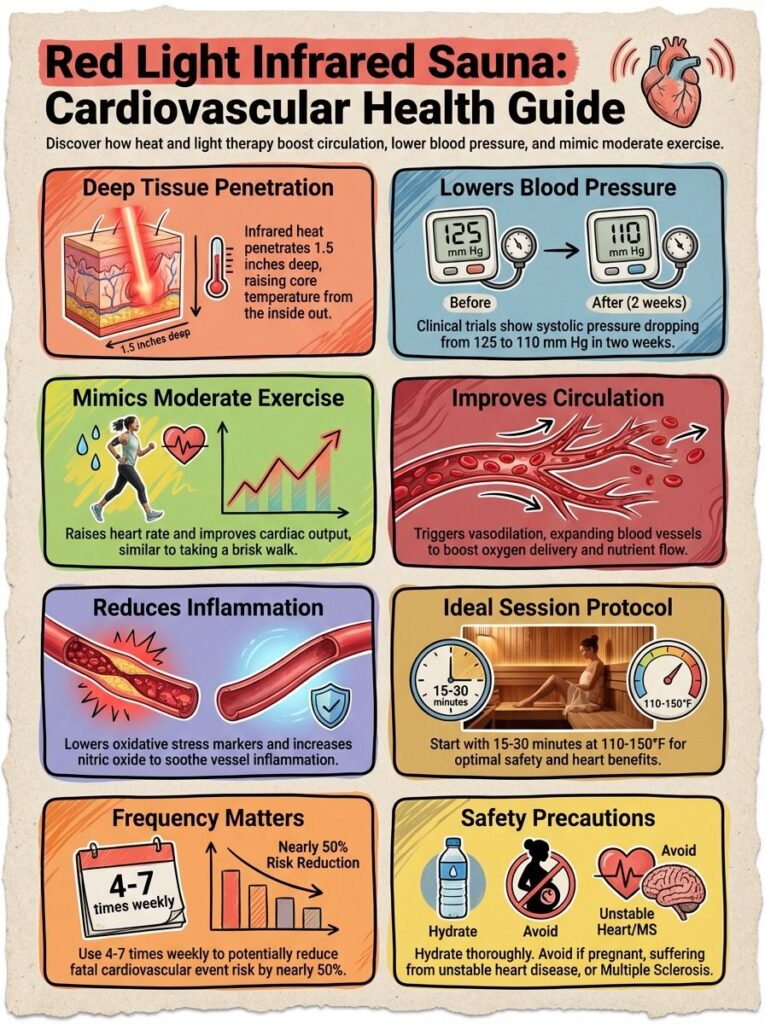
Infrared Sauna and Heart Health: From Prevention to Treatment — What the Cardiology Research Shows (2026)
Read article
Infrared Saunas and Blood Pressure: The Observational Promise and the RCT Reality (2026)
Read articleBuilt for Daily Use, Designed for Your Life Stage
Custom designed with handrails, appropriate bench height, and placement that minimizes distance from your living space. Available every day, on your schedule.