
Red Light Therapy in Infrared Saunas: The Complete Science of Integration (2026)
Key Takeaways
- Red light (660nm/850nm) stimulates mitochondrial ATP via cytochrome c oxidase (photochemical). Far infrared raises core temp via water absorption (thermal). Complementary, not redundant
- Inverse square law: a panel at 2 inches delivers ~36x the dose of one at 12 inches. Bench-integrated at 2-4" delivers dramatically more than wall-mounted at 12-24" — even with a higher-wattage wall panel
- Clinical PBM requires 50-100 mW/cm² at skin. Most wall-mounted sauna panels at 12+ inches deliver sub-therapeutic irradiance. You get red glow, not photobiomodulation
- Simultaneous IR + red light = genuine synergy: vasodilation distributes photobiomodulated cells faster, sweating clears the optical barrier, HSPs + ATP = two complementary repair pathways
- SaunaCloud's integration is optional — every plan includes wiring provisions for retrofit. Bench-integrated at clinical proximity, independently controllable, heat-rated to 160°F
Red light therapy is the most legitimate addition to infrared sauna technology in the last decade. Not chromotherapy (decorative colored lights with no clinical evidence). Not "full spectrum" heaters (which can't produce the claimed wavelengths). Red light therapy — specifically photobiomodulation at 660nm and 850nm — has a robust, growing evidence base for cellular repair, collagen production, muscle recovery, and anti-inflammatory effects.
But most sauna companies add red light panels as a marketing checkbox. They mount LED strips on the wall, 2-3 feet from your body, and claim 'integrated red light therapy.' The physics of photobiomodulation make this approach nearly worthless — irradiance drops with the square of distance. At 24 inches, most panels deliver sub-therapeutic doses. You're getting ambient red glow, not therapy.
SaunaCloud approaches red light integration the same way we approach heater placement — by starting with the physics. The single variable that determines therapeutic effectiveness is proximity. Our bench-integrated system places medical-grade LED panels 2-4 inches from your body. Not a marketing decision. An engineering decision based on the inverse square law.
Photobiomodulation: what happens at the cellular level
Photobiomodulation (PBM) is a photochemical process — not thermal — where photons at specific wavelengths are absorbed by chromophores in your cells. The primary target is cytochrome c oxidase (CCO) in the mitochondrial electron transport chain. When photons at 660nm or 850nm are absorbed by CCO, they release nitric oxide from the enzyme's binding site, restoring electron flow and increasing ATP production.
Downstream effects: faster cellular repair, increased collagen synthesis (fibroblasts produce more collagen/elastin), reduced oxidative stress, reduced inflammation (NF-κB modulation), and accelerated wound healing.
Two clinically relevant wavelengths: 660nm (visible red) penetrates 5-10mm — skin, superficial vessels, dermis. Optimal for collagen, skin health, surface healing. 850nm (near-infrared, invisible) penetrates 30-40mm — muscle, joint, connective tissue. Optimal for deep recovery, joint inflammation, muscle repair.
Why proximity is the only variable that matters
Irradiance — power density of light at skin, measured in mW/cm² — follows the inverse square law. Double the distance = quarter the irradiance.
A panel delivering 100 mW/cm² at 2 inches delivers ~25 mW/cm² at 4 inches, ~11 mW/cm² at 6 inches, ~3 mW/cm² at 12 inches, and <1 mW/cm² at 24 inches.
Clinical PBM research establishes a therapeutic threshold of 50-100 mW/cm² at skin surface. Below this, photons are absorbed but the dose doesn't trigger the ATP cascade. You see red light. You don't get therapy.
A wall-mounted panel at 12-24 inches — the standard in most 'red light therapy saunas' — delivers sub-therapeutic irradiance regardless of rated output. A $2,000 high-wattage panel at 24 inches delivers less therapeutic dose than a $500 panel at 3 inches. This is why bench-integrated exists.
Why simultaneous use is more effective than sequential
Mechanism 1 — Vasodilation enhances distribution: IR heat dilates blood vessels, increasing flow 30-50%. Photobiomodulated cells and their ATP payload are distributed to repair sites far faster than resting circulation.
Mechanism 2 — Sweating clears the optical barrier: The stratum corneum (outermost dead skin layer) scatters photons. Sweating during IR sessions reduces the skin's optical density — more 660nm photons reach living cells beneath. Sweating literally makes the therapy work better.
Mechanism 3 — Complementary repair pathways: IR activates heat shock proteins (damage identification/triage). Red light activates ATP production (repair energy). Together: cells get both the repair instructions AND the energy to execute them.
Mechanism 4 — Parasympathetic state enhances recovery: IR shifts to rest-and-digest mode. The cellular energy boost from PBM is directed toward repair rather than consumed by stress-response metabolism.
A 2018 NASA study demonstrated that combining mild heat with 660nm/850nm boosted collagen synthesis beyond light alone. Heat prepares the tissue, light provides the cellular energy, combined effect exceeds sequential use.
How SaunaCloud engineers red light integration
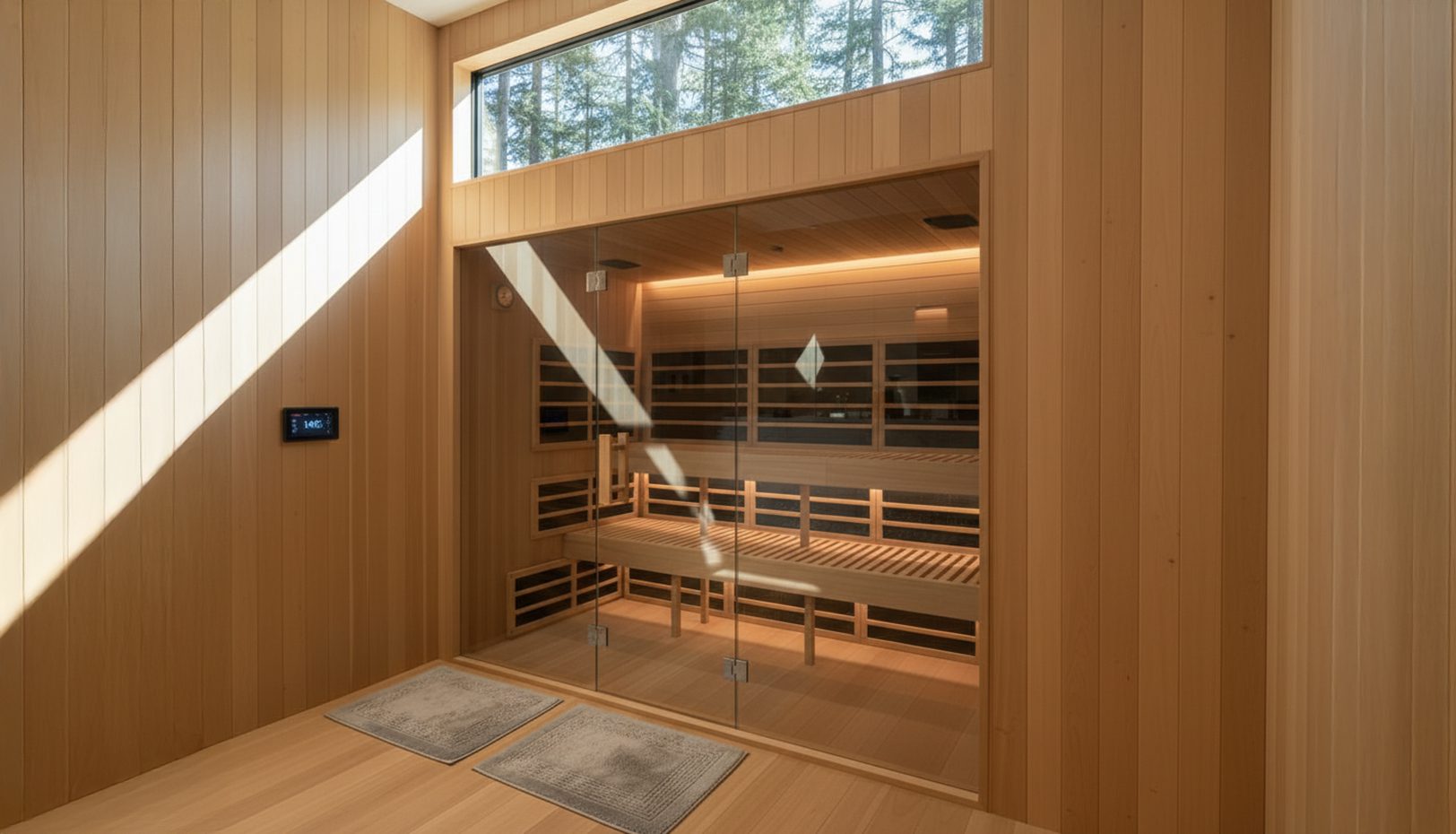
Lie-down configuration: 660nm + 850nm LED arrays embedded beneath cedar bench slats. Face down 15 minutes → entire back, shoulders, glutes, hamstrings, calves. Face up 15 minutes → chest, abdomen, quads, arms, face. Complete 360° coverage in 30 minutes.
Seated configuration: LEDs in backrest and lower bench at 3-6 inches. Less coverage than lie-down but dramatically closer than wall-mounted.
Independent control via WiFi module: run simultaneously with IR (recommended), red light only at room temperature for pure PBM, or IR only. All panels heat-rated to 160°F continuous — standard consumer panels overheat and fail in sauna environments.
Evaluating red light integration: 5 questions for any manufacturer
1. What irradiance (mW/cm²) at the actual treatment distance? The only number that matters. Threshold: 50-100+ mW/cm².
2. What specific wavelengths? Must be 630-660nm and/or 810-850nm. 'Red LEDs' without nanometers may not be therapeutic. Chromotherapy (decorative rainbow LEDs) has zero clinical evidence.
3. How far are panels from the body during normal use? Wall-mounted 18-24" = decorative. Bench-integrated 2-6" = therapeutic.
4. Are panels rated for sauna temperatures? Consumer panels fail at 130-160°F.
5. Can you run red light independently? Pure PBM sessions at room temp are valuable for facial treatments and wound healing.
What the research shows
NASA 2018: Heat + 660nm/850nm boosted collagen synthesis beyond light alone. 2024 International Journal of Molecular Sciences: PBM at 660nm increases type I collagen density, reduces wrinkle depth. Journal of Biophotonics (46 trials meta-analysis): PBM consistently reduced muscle damage markers and soreness. Avci et al., 2013: Transepidermal changes during sweating reduce optical density, improving photon penetration.
Honest caveat: most PBM studies use standalone LED devices in clinical settings, not sauna-integrated panels. The synergy evidence (heat + light together) is growing but still primarily mechanistic and early-stage. SaunaCloud's integration is based on individual evidence bases for each modality plus the physiological logic of their synergy — not on a definitive RCT of bench-integrated sauna PBM.
Frequently Asked Questions
The PBM mechanism is identical — same wavelengths, same cellular target, same ATP production. The difference: in a sauna you also get vasodilation (enhanced distribution), cleared stratum corneum (better penetration), HSP activation (complementary repair), and parasympathetic state (recovery context). Standalone works. Sauna-integrated works better through synergy.
Yes — but use a panel rated for 160°F+ continuous. Standard consumer panels overheat and fail. Mount as close to your body as possible — bench or chair-back, not wall. Hooga SaunaPRO and Recover Red are aftermarket panels designed for in-sauna use.
No. Chromotherapy uses low-power decorative LEDs cycling through colors for ambiance — unspecified wavelengths, zero clinical evidence for photobiomodulation. Red light therapy uses high-power LEDs at precisely 660nm and 850nm at therapeutic irradiance. They look similar. They are completely different technologies.
Optional add-on, pricing varies by bench configuration and coverage. Every set of plans includes wiring provisions and mounting locations regardless — so adding later requires minimal modification. This is true whether you order red light initially or not.
Yes — independent control via WiFi module. Run red light at room temperature for pure PBM. Useful for facial treatments, wound healing, or anytime you want cellular therapy without sweating.
Skin improvements: 4-8 weeks consistent use. Muscle recovery: 2-4 weeks. Chronic pain/inflammation: 6-12 weeks. Consistency matters more than session intensity. The compounding effect of daily IR + red light is where the real transformation happens.
Founder & Lead Designer, SaunaCloud®
3,000+ custom saunas built since 2014 · Author of The Definitive Guide to Infrared Saunas · Featured in Forbes, Inc., and MSN
Chris has been designing and building custom infrared saunas since 2014. He wrote one of the first comprehensive books on infrared sauna therapy and is personally involved in every SaunaCloud build — from design consultation through delivery and beyond.
Continue Reading
Near Infrared vs Far Infrared Saunas: The Physics-Based Guide to Choosing (2026)
Read article
Full Spectrum Infrared Saunas: The Physics Behind the Marketing (2026)
Read article
Infrared Sauna Health Benefits: The Complete Science-Backed Guide (2026)
Read articleAdd Red Light Therapy at Clinical Proximity
Design a custom sauna with bench-integrated 660nm + 850nm LED panels — genuine photobiomodulation, not decorative accent lighting.