
The Infrared Sauna Buying Guide: 10 Things to Know Before You Buy (2026)
Key Takeaways
- Heater technology is the single most important factor — surface temperature determines wavelength output, and wavelength determines therapeutic effectiveness (Wien's Law)
- EMF varies 100-500x between brands: cheap imports produce 20-100 mG while VantaWave® averages <0.20 mG. For daily 30-minute use, cumulative exposure matters
- Western Red Cedar is the gold standard — naturally antimicrobial, dimensionally stable through heating cycles, and aromatic. Hemlock, basswood, and plywood are cost-cutting substitutes
- Warranty tells you everything about a company's confidence: 7-year coverage (SaunaCloud) vs 1-3 years (most imports) reveals expected product lifespan
- If a company can't tell you their heater's peak emission wavelength or surface temperature, that's the biggest red flag in the industry
Since founding SaunaCloud in 2014, I've helped over 3,000 clients navigate the infrared sauna market. I've also seen countless people waste money on cheap saunas that fail within years, forcing them to start over. The search for a quality infrared sauna is genuinely confusing — and the industry has made it that way on purpose.
This guide covers the 10 critical factors that separate a therapeutic infrared sauna from an expensive disappointment. I wrote it because I got tired of watching people spend $5,000 on beautiful cabinets that don't actually work. By the end, you'll know exactly what questions to ask any manufacturer — including us — and which answers reveal the truth about quality.
1. Heater technology: the single most important factor
Your heaters are the heart of your infrared sauna. Every health benefit you're hoping to get depends entirely on heater quality. And this is where most companies cut corners.
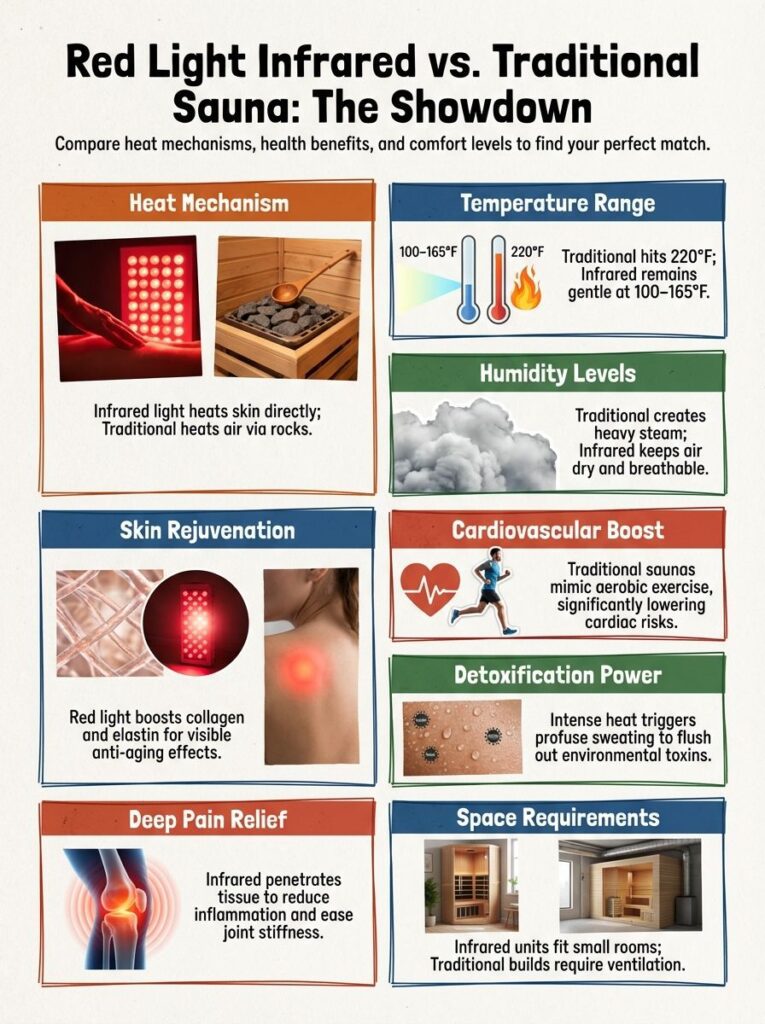
There are three types of infrared heaters: carbon panels, ceramic elements, and halogen bulbs. Each operates at a different surface temperature, which — per Wien's Law — means each produces a different wavelength of infrared light. That wavelength determines how deeply the infrared penetrates your tissue and how effectively it raises your core temperature.
Carbon panels are cheap to manufacture and cover a lot of surface area — but at 140-150°F surface temperature, they produce wavelengths that are too long to penetrate deeply. You'll warm up slowly and sweat eventually, but you won't get the core temperature elevation that drives real cardiovascular and metabolic benefits.
Ceramic heaters run much hotter (350-400°F) and produce shorter, more intense infrared — but they're concentrated in small areas, creating hot spots. They can also produce higher EMF.
Our VantaWave® heaters are engineered to hit the therapeutic sweet spot: 190°F+ surface temperature producing peak emission at 7.9 microns — the wavelength human tissue absorbs most efficiently. We manufacture these in-house along with our CORE 5™ power supply and control electronics.
The test: ask any sauna company what their heater's peak emission wavelength is and what surface temperature produces it. If they can't answer, they don't understand their own product.
2. EMF levels: the hidden health variable
EMF — electromagnetic fields — is produced by every electrical device. The concern with infrared saunas is proximity: you're sitting 6-12 inches from heaters for 30-40 minutes, 4-7 times per week. That's hundreds of hours per year of close-range exposure.
Most infrared saunas produce 20-100 mG at seated positions. The WHO recommends limiting prolonged exposure to 3 mG or less. VantaWave® heaters average less than 0.20 mG — that's 100-500x lower than most competitors, and 15x below WHO guidelines.
The test: ask for third-party EMF testing results measured at the seated position, not at the wall or with heaters off. If a company doesn't publish EMF data, assume the worst.
3. Wood selection: it's not just aesthetics
The type of wood in your sauna affects durability, hygiene, comfort, and long-term maintenance. Western Red Cedar is the gold standard for several reasons: it's naturally antimicrobial and antifungal, dimensionally stable through thousands of heating/cooling cycles, has a pleasant therapeutic aroma, and is soft and comfortable against bare skin.
Budget manufacturers use hemlock, basswood, or even laminated plywood to cut costs. These materials warp over time with repeated heat exposure, don't have natural antimicrobial properties, and can off-gas adhesive chemicals when heated — exactly the opposite of what you want in a detoxification chamber.
We use only clear-grade Western Red Cedar — no knots, no filler, no lamination.
4. Heater placement: 360° coverage vs wall-only
Most mass-produced saunas place heaters on 1-2 walls. You end up with one hot side and one cool side. Effective infrared therapy requires heater coverage from all directions — behind your back, beside your legs, overhead, and in front.
Our Atlas™ heater placement system positions VantaWave® panels strategically around the entire sauna interior. Infrared energy follows the inverse square law — intensity drops rapidly with distance. Having heaters on all sides at consistent proximity ensures even therapeutic delivery to your entire body.
5. Electrical: 120V vs 240V and what it means for your home
Most quality 1-2 person infrared saunas run on a standard 120V household outlet. Larger models (3-4 person) may require a 240V dedicated circuit, which means hiring an electrician. Know your electrical situation before you buy.
Our CORE 5™ power supply is engineered to maximize heater output on standard residential circuits. For larger custom builds that require 240V, we provide detailed electrical specifications for your contractor.
6. Warranty: the ultimate confidence test
A company's warranty tells you exactly how long they expect their product to last. If they offer 1-3 years of coverage, they're telling you the sauna might not make it past that. If they offer 7 years (our residential warranty), they're betting on their engineering.
Read the fine print. Some warranties cover only the cabinet but not the heaters — which is the component most likely to fail. Some require you to pay for shipping parts back and forth. Ours covers everything including parts, service, and shipping.
The test: ask what the warranty covers specifically, who pays for parts shipping, and what their heater failure rate is. Our heater failure rate after 3,000+ installations is effectively zero.
7. Custom vs prefab: which is right for you
Prefab (pre-fabricated) saunas arrive as a complete cabinet that you assemble in place. They're faster to set up but limited to standard sizes and configurations.
Custom saunas — like what SaunaCloud builds — are designed for your specific space. We provide detailed plans and your contractor installs the cedar, heaters, and electrical to fit your exact dimensions. This means you can build into a closet, a bathroom corner, a garage alcove, or any non-standard space.
Custom also means you choose your bench configuration, door style, glass, red light therapy integration, and heater placement. Every SaunaCloud installation is unique to the customer.
8. Red light therapy: proximity matters
Red light therapy (photobiomodulation) at 660nm and 850nm wavelengths has strong clinical evidence for skin rejuvenation, wound healing, inflammation reduction, and muscle recovery. Many sauna companies are now adding red light panels — but how they integrate them determines whether you get therapeutic benefit or just a nice glow.
The critical variable is proximity. Clinical studies showing real results use light panels within 2-6 inches of the skin. Most sauna companies mount panels on the wall 2-3 feet from where you sit — too far for therapeutic dosage.
SaunaCloud integrates red light therapy directly into the bench system, within the clinically proven treatment range. This is a fundamentally different approach — and it's why our red light integration actually delivers the dosage that research supports.
9. Red flags in the sales process
After 12 years in this industry, here are the warning signs that a sauna company isn't trustworthy:
They pressure you with limited-time discounts. Quality manufacturers don't need artificial urgency. They can't explain their heater technology in detail. They claim 'full spectrum is always better' without explaining why. They don't publish EMF testing data. Their warranty is under 5 years. They sell through Amazon or discount retailers (those units are designed for price, not performance). They have no direct phone line to an engineer or founder.
At SaunaCloud, you talk directly to me or my team. We'll answer every technical question, send you EMF data, and walk you through exactly how we build your sauna. We don't do pressure sales because we don't need to — our engineering speaks for itself.
10. The most important question: will you use it every day?
This is the factor nobody talks about, and it matters more than everything else combined. The health benefits of infrared sauna therapy come from consistent, daily use over months and years. A beautiful $15,000 sauna that you use twice a month delivers zero long-term benefit.
When evaluating any sauna, ask yourself: is this comfortable enough to sit in for 30 minutes every single day? Is the heat-up time fast enough that I won't skip sessions? Is it convenient to access in my home? Will I actually build this into my routine?
This is why comfort, convenience, location, and heat-up speed matter so much. The 'best' sauna on paper is worthless if it collects dust. The sauna you use daily — even if it's simpler — will transform your health.
Frequently Asked Questions
Expect to invest $3,000-$8,000 for a quality prefab model and $5,000-$15,000+ for a custom-built sauna. Budget models under $2,000 consistently use inferior heaters, cheap wood, and minimal warranty coverage. The difference in therapeutic output between a $2,000 and $8,000 sauna is significant — it's not just a premium for brand name.
Heater peak emission wavelength and surface temperature. These determine how effectively the sauna raises your core body temperature, which is the mechanism behind every health benefit. If a company can't tell you these numbers, move on.
Not necessarily. 'Full spectrum' adds near and mid infrared, which have different therapeutic applications (primarily skin health). The vast majority of clinical research on cardiovascular health, longevity, and detoxification involves far infrared. SaunaCloud uses far infrared for heating and integrates red light therapy separately at clinical proximity for skin/cellular benefits — this is a more effective approach than trying to do everything with the sauna heaters.
Ask for third-party testing results measured at the seated position with heaters at full power. Some companies test at the wall (lower reading) or at partial power. VantaWave® averages <0.20 mG at the seated position at full power.
For a serious therapeutic sauna, buy direct from the manufacturer. Amazon saunas are designed to hit a price point, not a therapeutic threshold. You also get no customization, limited warranty support, and no direct access to engineers or designers. For a $5,000+ wellness investment, the relationship with your manufacturer matters.
Ask these five: (1) What is your heater's peak emission wavelength and surface temperature? (2) What are your EMF levels at the seated position? (3) What wood do you use and where is it sourced? (4) What exactly does your warranty cover, and who pays for parts shipping? (5) What is your heater failure rate?

Founder & Lead Designer, SaunaCloud®
3,000+ custom saunas built since 2014 · Author of The Definitive Guide to Infrared Saunas · Featured in Forbes, Inc., and MSN
Chris has been designing and building custom infrared saunas since 2014. He wrote one of the first comprehensive books on infrared sauna therapy and is personally involved in every SaunaCloud build — from design consultation through delivery and beyond.
Continue Reading

How Infrared Saunas Work: From Photon to Health Effect in Five Steps (2026)
Read article
Infrared Sauna vs Traditional Sauna: The Honest Comparison (2026)
Read article
Infrared Sauna Heater Comparison: What Every Buyer Needs to Know
Read articleReady to Invest in the Right Sauna?
Talk directly to a sauna designer — not a salesperson. We'll walk you through your space, your goals, and exactly how we build.